Digital Menu Board Guide for Restaurants and QSR Chains: The Complete B2B Operational Playbook
In the high-velocity world of Quick-Service Restaurants (QSRs), fast-casual dining, cafés, and bubble tea franchises, the ordering counter is ground zero for customer engagement and revenue generation. The menu board is not merely a static list of food items and prices—it is your restaurant’s most potent silent salesperson.
Yet, thousands of multi-unit food operators remain constrained by obsolete static printed boards and cardboard inserts. Static boards suffer from glaring operational vulnerabilities:
- Costly, Slow Menu Updates: Introducing seasonal specials or updating prices requires re-printing, shipping, and manual installation across dozens or hundreds of store locations.
- Inflexible Dayparting: Transitioning manually from breakfast to lunch menus wastes valuable staff time during peak morning rush hours.
- Missed Upsell Opportunities: Static images cannot showcase sizzle, steam, bubbling beverages, or dynamic combo promotions that stimulate appetite and drive impulse purchases.
- Regulatory Compliance Headaches: Strict FDA and international nutrition disclosure laws mandate precise calorie and allergen displays, making manual updates risky and cumbersome.
Upgrading to commercial-grade 4K digital menu boards completely transforms food service operations. Industry data indicates that dynamic digital menu boards deliver an immediate 3% to 8% increase in overall sales, reduce perceived wait times by up to 35%, and achieve full ROI within 9 to 12 months.
In this definitive guide, we explore how to select, deploy, and scale digital menu boards across multi-unit restaurant networks, backed by manufacturing insights from Kontech, a premier commercial display manufacturer with 17+ years of experience and over 100,000 digital menu board units produced globally.
1. The Core Digital Menu Board Lineup: Choosing the Right Form Factor
Commercial food service environments vary drastically—from brightly lit indoor checkout counters to harsh outdoor drive-thru lanes. Kontech’s specialized digital menu board portfolio spans four primary configurations:
Restaurant & QSR Digital Display Ecosystem:
┌────────────────────────────────────────────────────────────────────────┐
│                        CENTRAL CLOUD CMS / POS                         │
└──────┬────────────────────┬────────────────────┬──────────────────┬────┘
       │                    │                    │                  │
       ▼                    ▼                    ▼                  ▼
[1. INDOOR OVERHEAD]  [2. DRIVE-THRU]   [3. SELF-ORDER]     [4. DESKTOP]
• 32" to 86"          • 43" to 86"      • 32" to 65"        • 21.5" to 32"
• 700 Nits 4K         • 1,500–3,000 Nits• 10-Point Touch    • Cashier / Counter
• Multi-Screen Sync   • Weatherproof    • Self-Service POS  • Bubble Tea / Cafe
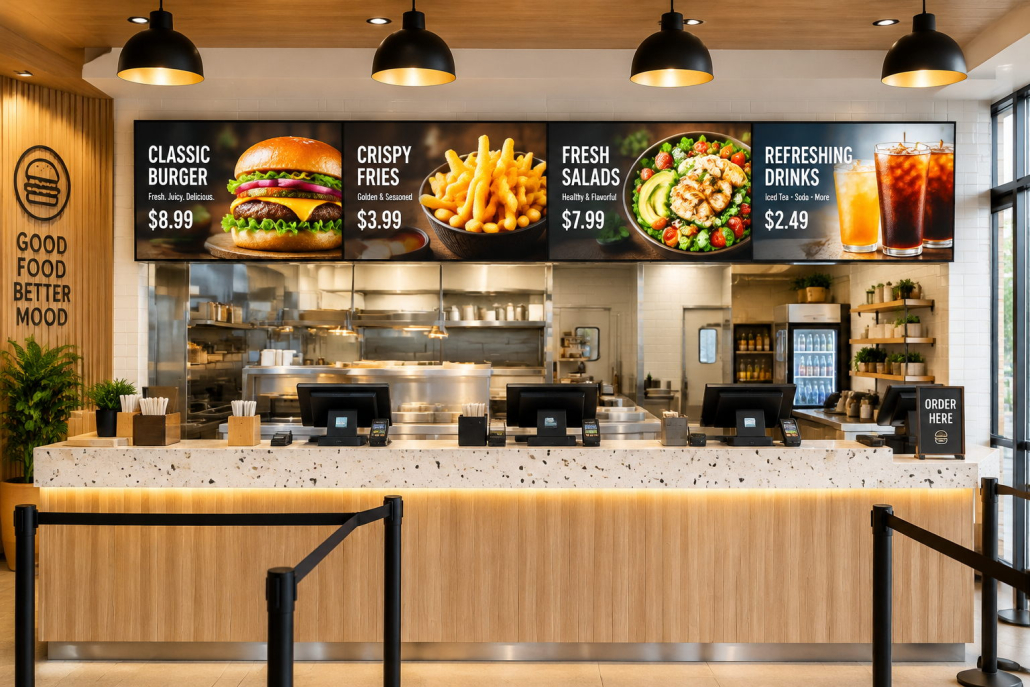
A. Indoor High-Brightness Overhead Menu Boards (32″ to 86″, 700 Nits)
- Deployment Location: Mounted seamlessly in a horizontal or vertical array above the main ordering and service counter.
- Key Specifications: 700 nits commercial brightness, 4K Ultra HD resolution (3840×2160), ultra-narrow aluminum alloy bezel, 178° wide viewing angles, landscape and portrait orientation support.
- Operational Value: 700 nits of calibrated brightness cuts through intense restaurant overhead halogen and LED spotlights without screen glare or color washout. Text remains razor-sharp from 10 to 30 feet away, ensuring customers decide their orders before reaching the cashier, significantly speeding up queue throughput.
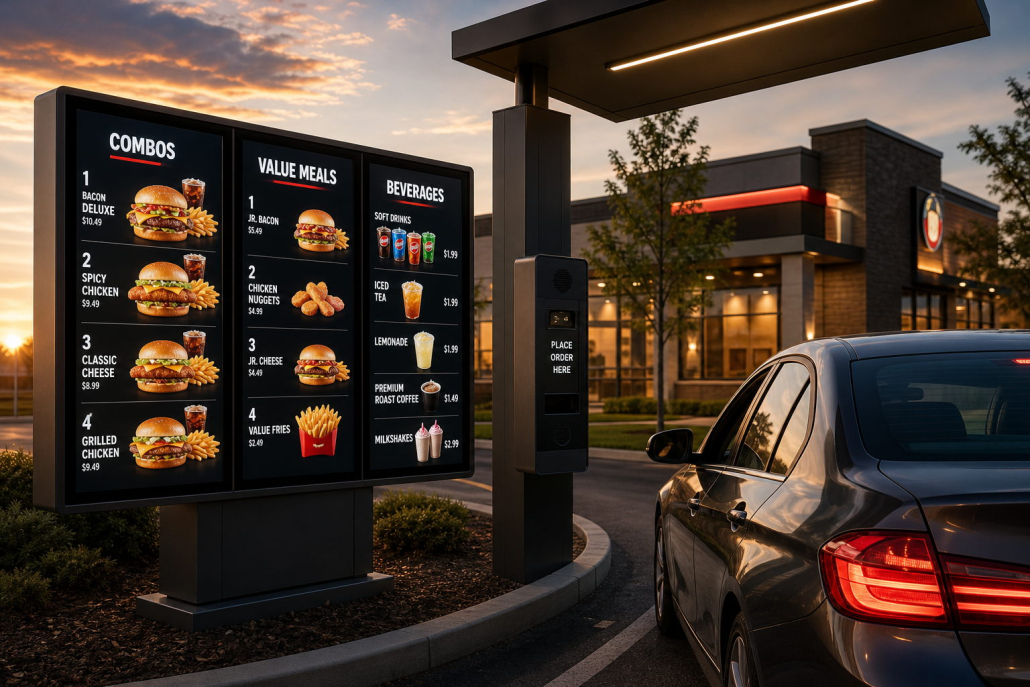
B. Outdoor Digital Drive-Thru Menu Boards (43″ to 86″, 1,500 to 3,000 Nits)
- Deployment Location: Outdoor drive-thru lanes (Pre-sell board, Main ordering board, and Confirmation pickup board).
- Key Specifications: 1,500 to 3,000 nits sunlight-readable panels, IP55/IP65 weatherproof sealed metal enclosures, anti-reflective shatterproof glass, High-TNI panels resisting direct solar heat up to 110°C, internal temperature control fans and heating elements.
- Operational Value: With drive-thru generating 60% to 70% of total revenue for modern QSRs, outdoor boards guarantee flawless legibility under midday summer sun and sub-zero winter blizzards.
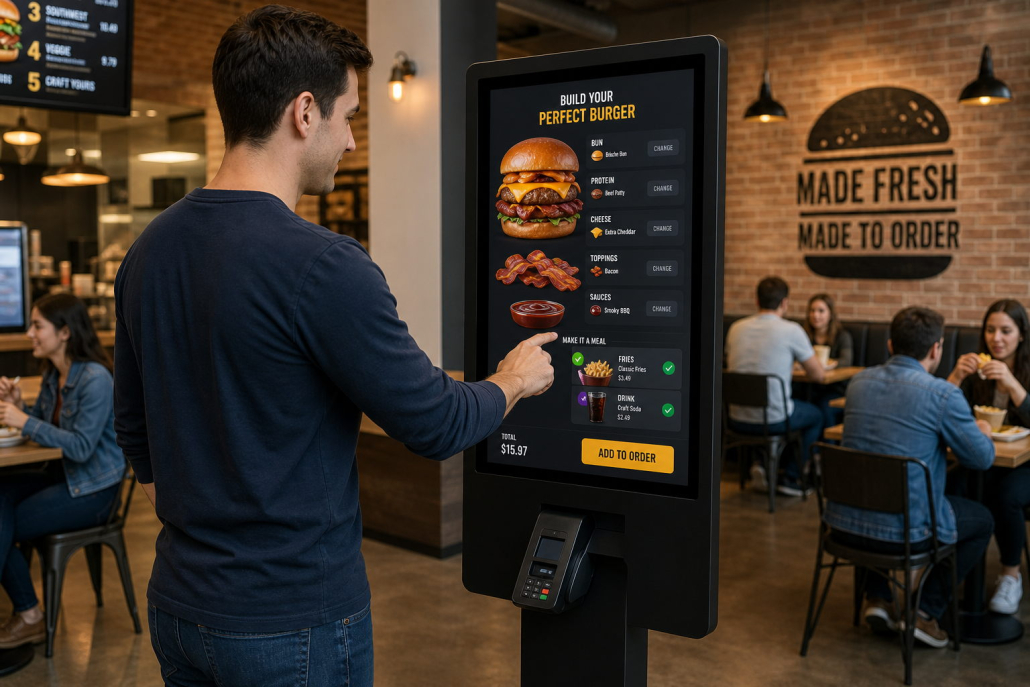
C. Touch Screen Self-Service Ordering Kiosks (32″ to 65″)
- Deployment Location: Storefront entryway and lobby ordering zones.
- Key Specifications: 10-point PCAP capacitive touch screen, 3–5mm tempered protective glass, built-in barcode/QR scanners and POS card reader brackets, Android or Windows OS.
- Operational Value: Empowers guests to customize combo meals, browse ingredients, and pay autonomously, consistently increasing average order value (AOV) by 15% to 25% through automated upsell prompts (e.g., “Add extra bacon?”, “Upgrade to large fries?”).
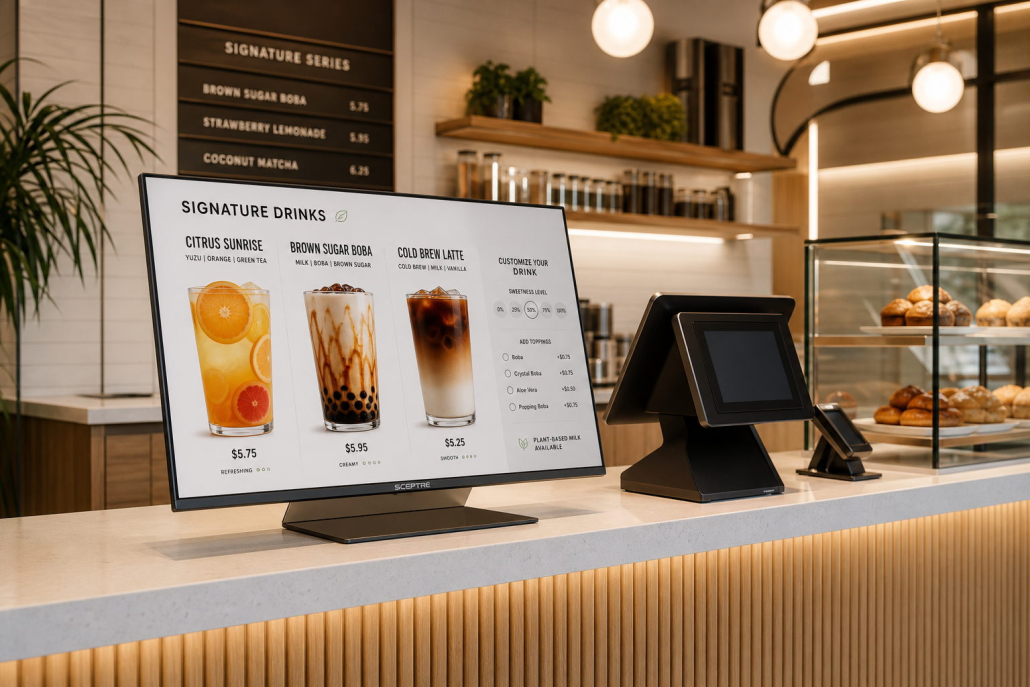
D. Desktop & Countertop Digital Menu Boards (21.5″ to 32″)
- Deployment Location: Positioned directly on the checkout counter beside the POS cash register, pickup shelves, or drink prep counters.
- Key Specifications: Compact footprint, sturdy desktop L-shape or angled metal base, vibrant 1080P/4K display, HDMI/USB/LAN/Wi-Fi connectivity.
- Operational Value: The gold standard for specialty coffee shops, boba/milk tea counters, and bakeries. Perfect for showcasing seasonal drink specials, loyalty rewards, and instant add-ons right at the moment of payment.
2. Multi-Screen Synchronization & Dynamic Dayparting: The Power of Cloud CMS
Managing menus across 10 or 1,000 restaurant locations requires an intuitive, cloud-based Content Management System (CMS). Kontech digital menu boards feature integrated Android and Windows media engines that support industry-standard CMS platforms:
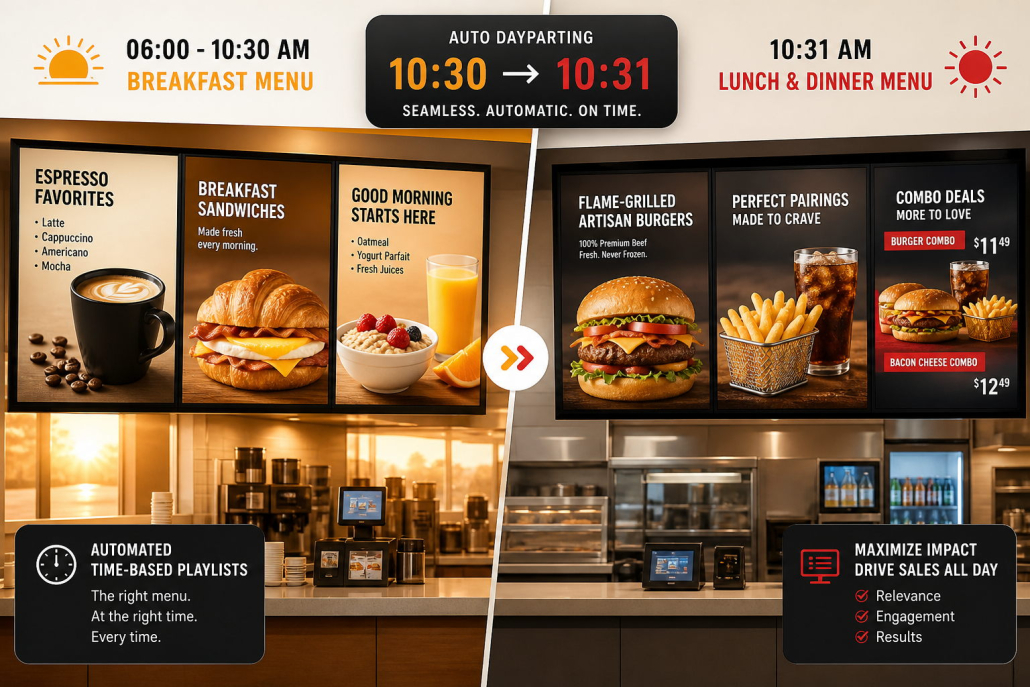
Feature 1: Automated Dayparting (Zero Staff Effort)
Restaurant dining patterns shift dramatically throughout the day:
- 06:00 – 10:30 (Breakfast): Highlighting hot artisan coffee, breakfast wraps, and morning combos.
- 10:31 (Instant Switch): All screens across the entire chain synchronously switch to the lunch menu without staff touching a button.
- 14:00 – 17:00 (Afternoon Slump): Emphasizing happy hour beverages, sweet pastries, and snack combos.
- 17:01 – 22:00 (Dinner): Featuring family-sized value meals, premium burger combos, and desserts.
Feature 2: Multi-Screen Video Canvasing & Synchronous Playback
Instead of three isolated screens displaying static text, modern QSRs utilize synchronized video triggers:
- Every 15 minutes, all 3 or 4 screens synchronize to display a dramatic, full-width 4K promotional animation—such as an appetizing burger assembling in slow motion or refreshing fruit pouring into an iced beverage. This synchronized visual “takeover” instantly commands the entire lobby’s attention.
Feature 3: Real-Time POS Integration & Automated “86” (Sold-Out) Triggers
When integrated with your restaurant POS system (Toast, NCR Aloha, Revel, Square, etc.), digital menu boards update instantly:
- If inventory for a limited-time special runs out, the POS automatically notifies the CMS to remove the item or display a subtle “Sold Out” tag, eliminating customer disappointment and awkward cashier explanations.
- Price adjustments across regional corporate stores and franchised tiers deploy chain-wide in seconds.
3. Commercial Display vs. Consumer TV: Why Consumer TVs Fail in Restaurants
Many independent restaurant owners make the expensive mistake of buying budget consumer TVs from big-box retailers. In a demanding restaurant environment, consumer TVs fail within months:
4. Real-World Case Study: U.S. Quick-Service Restaurant Chain 4K Rollout
When a nationwide American quick-service restaurant chain embarked on a digital transformation across its multi-state locations, they partnered with Kontech for hardware manufacturing:
- Customer Challenge: The client required high-definition, high-brightness displays capable of operating 16 to 24 hours daily in brightly lit restaurant environments, with ultra-crisp menu text legibility and rapid cloud content synchronization.
- The Kontech Solution: Kontech delivered a customized 4K Ultra-High-Definition High-Brightness Digital Menu Board System:
- Integrated 700-nit commercial panels with light sensor auto-adjustment.
- Slim-bezel multi-screen mounting infrastructure for 3-screen and 4-screen horizontal ceiling configurations.
- Embedded Android SoC media engine with Wi-Fi and robust LAN connectivity.
- The Business Outcome: The chain achieved a 14% increase in promotional combo sales, eliminated over $180,000 in annual printed menu material and shipping costs, and established seamless 60-second menu updates across all participating stores.

