Commercial Display vs Consumer TV for Digital Signage: Can I Use a Smart TV?
When retail store managers, restaurant owners, or corporate facility directors budget for a digital signage project, the same tempting question inevitably arises:
“A 55-inch consumer smart TV costs $350 at Walmart or Best Buy, while a professional 55-inch commercial display costs $800 to $1,200. They both have 4K resolution and HDMI ports. Why shouldn’t I just buy four cheap consumer smart TVs to display my digital menus and in-store promotions? Can I use a smart TV for digital signage?”
At first glance, the price delta appears massive. On a 10-screen deployment, opting for consumer TVs seems to save thousands of dollars in upfront capital expenditure (CAPEX).
However, commercial AV integrators and experienced enterprise operators know that substituting consumer TVs for commercial displays is the single most expensive mistake a business can make. What looks like an upfront bargain transforms within 6 to 12 months into a compounding nightmare of overheating shutdowns, permanent screen burn-in ghosting, unreadable mirror glare, voided manufacturer warranties, and premature replacement expenses.
Drawing upon Kontech’s commercial display engineering standards (700-nit continuous-duty indoor screens, 2,000–3,000 nit sunlight-readable window displays, industrial aluminum thermal chassis, and 3-year commercial warranties), this comprehensive guide breaks down the four critical engineering differences between consumer TVs and commercial displays—helping you make a scientifically grounded, financially sound investment.
The Fundamental Engineering Dichotomy: Built for Living Rooms vs. Built for Business
Before examining specific technical metrics, it is vital to understand the fundamental difference in design philosophy:
DESIGN PHILOSOPHY DICHOTOMY:
┌──────────────────────────────────────┬──────────────────────────────────────┐
│ CONSUMER SMART TV                    │ PROFESSIONAL COMMERCIAL DISPLAY      │
├──────────────────────────────────────┼──────────────────────────────────────┤
│ • Designed for: Living room couch    │ • Designed for: Public retail & QSR  │
│ • Daily Run-Time: 4 to 8 hours/day   │ • Daily Run-Time: 16/7 to 24/7 hours │
│ • Ambient Lighting: Dim domestic     │ • Ambient Lighting: 1,000+ lux retail│
│ • Content Type: Constantly moving    │ • Content Type: Static menus/prices  │
│ • Chassis: Thin enclosed plastic     │ • Chassis: Heavy-duty aluminum/metal │
│ • Orientation: Landscape ONLY        │ • Orientation: Landscape & Portrait  │
│ • Warranty: Voided in commercial use │ • Warranty: 3-Year Enterprise SLA    │
└──────────────────────────────────────┴──────────────────────────────────────┘
A consumer television is engineered to sit on a console table in a climate-controlled living room, playing constantly shifting movies or video games for 4 to 6 hours an evening.
A professional commercial display (such as Kontech’s indoor commercial series) is an industrial computing appliance, engineered to operate continuously in punishing commercial environments filled with ambient grease, dust, elevated temperatures, and aggressive 1,000-lux retail spotlights.
Critical Difference 1: 7×24 Thermal Dissipation & Duty Cycle
The primary factor dictating hardware survival in a commercial venue is thermal management.
The Consumer TV Limitation (6 to 8 Hours Maximum):
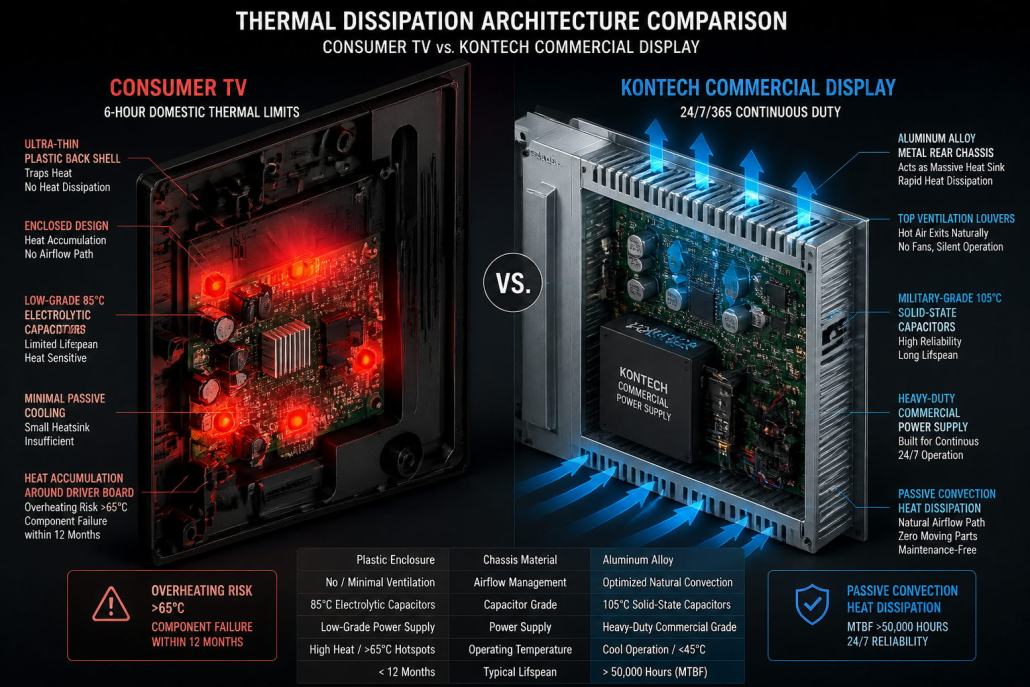
- Plastic Insulative Enclosure: To keep manufacturing costs at rock bottom, consumer TVs are housed in thin, injection-molded plastic shells. Plastic acts as a thermal insulator, trapping heat inside the chassis.
- Consumer-Grade Capacitors (85°C Rating): Internal power supply boards use low-cost electrolytic capacitors rated only for moderate temperatures and 6–8 hours of daily use.
- The Thermal Consequence: When a consumer TV is forced to run 14 to 24 hours a day in a commercial store, internal temperatures spike above 65°C (149°F). The trapped heat causes the backlight LEDs to discolor, thermal throttling circuits to shut the screen down unexpectedly, and internal capacitors to bulge and burst within 9 to 14 months.
The Kontech Commercial Engineering Architecture (24/7 Continuous Duty):
- Heavy-Duty Aluminum Alloy Chassis: Kontech commercial displays utilize structural aluminum alloy enclosures. Aluminum possesses a thermal conductivity over 200 times higher than plastic, turning the entire rear chassis into a massive passive heat sink.
- Engineered Airflow Convection: Precision-stamped ventilation channels allow natural convection cooling to pull cool air through the bottom and expel hot air out the top without requiring noisy external fans.
- Industrial Solid Capacitors (105°C Rating): Power supply units (PSU) utilize military- and industrial-grade solid-state capacitors rated for continuous 105°C operation, guaranteeing an Mean Time Between Failures (MTBF) exceeding 50,000 hours (over 5.7 years of non-stop 24/7/365 operation).
Critical Difference 2: Screen Burn-In & Static Image Retention
Retail digital signage and restaurant menu boards display static content: columns of text, product prices, brand logos, and dividing borders that remain stationary on the screen for 12 to 18 hours daily.
Why Consumer TVs Suffer Permanent Burn-In:
- Consumer LCD panels (and especially OLED televisions) are manufactured strictly for moving video.
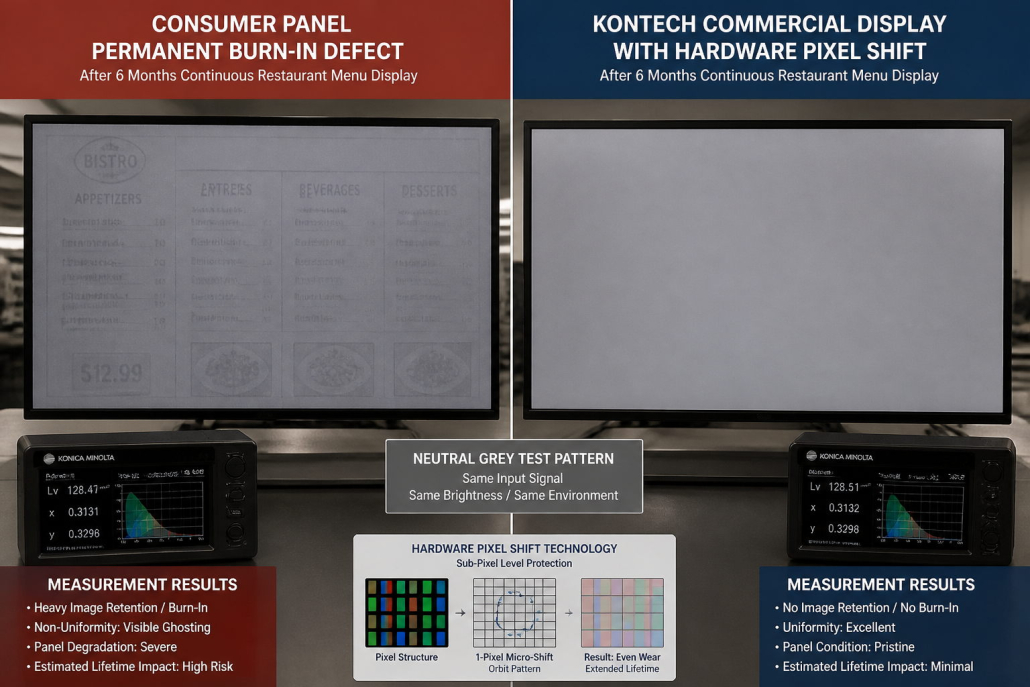
- When a static image is displayed continuously on a consumer panel, the liquid crystal molecules become physically polarized and trapped in an unrecoverable state, or the color filters suffer differential aging.
- Within 3 to 6 months, an indelible “ghost image” of your menu prices or logo is permanently burned into the panel. If you change your prices from $8.99 to $9.99, the old $8.99 remains visibly shadowed underneath, completely ruining your brand presentation.
How Kontech Commercial Displays Prevent Burn-In:
- Commercial-Grade Anti-Sticking Panels: Kontech commercial displays utilize premium BOE/LG commercial IPS panels engineered with enhanced molecular alignment stability.
- Automated Pixel-Shift Technology: Embedded firmware continuously shifts the entire image by 1 to 2 pixels horizontally and vertically at imperceptible intervals (every 10 to 30 minutes). The human eye cannot detect the microscopic shift, but it ensures that individual sub-pixels constantly alternate electrical states, 100% preventing static image retention.
- Automated Screen Refresh / Inversion Cycles: During scheduled off-hours, the display runs automated black-to-white wash cycles to clear any transient electrical memory.
Critical Difference 3: Anti-Glare Optical Coatings vs. Mirror Glare
In a retail store, supermarket, or quick-service restaurant, the ambient lighting environment is intense. Ceiling-mounted track spotlights, fluorescent tubes, and glass storefront daylight produce ambient illuminance ranging from 800 to 1,500 lux.
The Consumer TV Mirror Dilemma:
- Consumer televisions feature high-gloss glass screens designed to make colors look ultra-saturated in a dark living room.
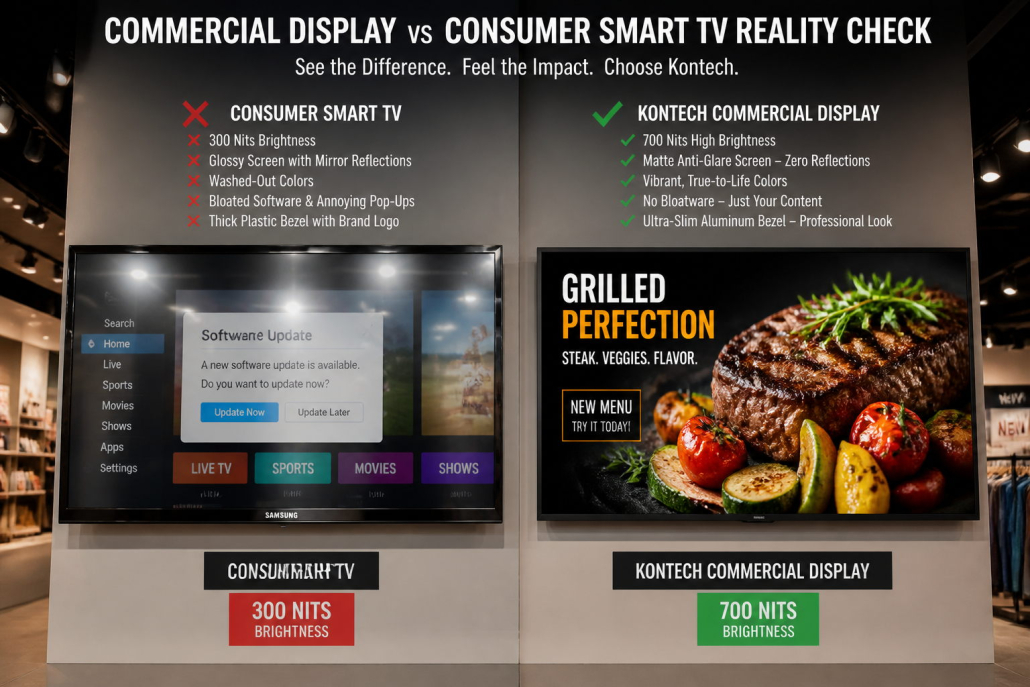
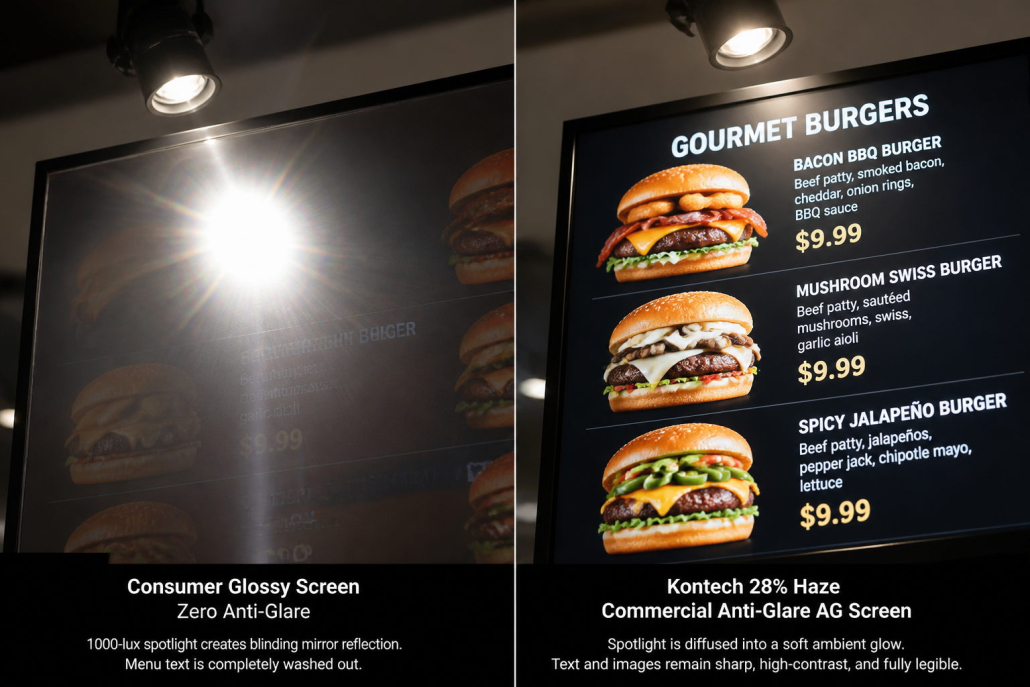
- Place a glossy consumer TV under commercial retail spotlights, and it behaves exactly like a giant glass mirror. Overhead lights create blinding white glare hotspots that completely obliterate the text underneath. Customers standing in line cannot read your menu items or promotional prices without awkwardly bobbing their heads to find an angle without reflection.
- Furthermore, consumer TVs only produce 250 to 350 nits of brightness, which is easily washed out by ambient retail ambient light.
Kontech Commercial Optical Engineering:
- Commercial High Luminance (700 to 2,500+ Nits): Kontech indoor displays deliver a standard 700 cd/m² (nits)—more than double the brightness of a consumer TV—ensuring dynamic imagery punches through intense indoor lighting. For storefront windows, Kontech window displays provide 2,000 to 3,000 nits of sunlight-readable luminance.
- Industrial Anti-Glare (AG) Matte Coating (25%–28% Haze): Kontech commercial screens feature a chemically etched optical anti-glare micro-surface. When ceiling spotlights strike the screen, the light is smoothly diffused in all directions rather than reflected back into the viewer’s eyes. Menus, prices, and high-resolution food imagery remain razor-sharp and legible from extreme 178°/178° viewing angles.
Critical Difference 4: Portrait Mode Support & Gravity Sagging
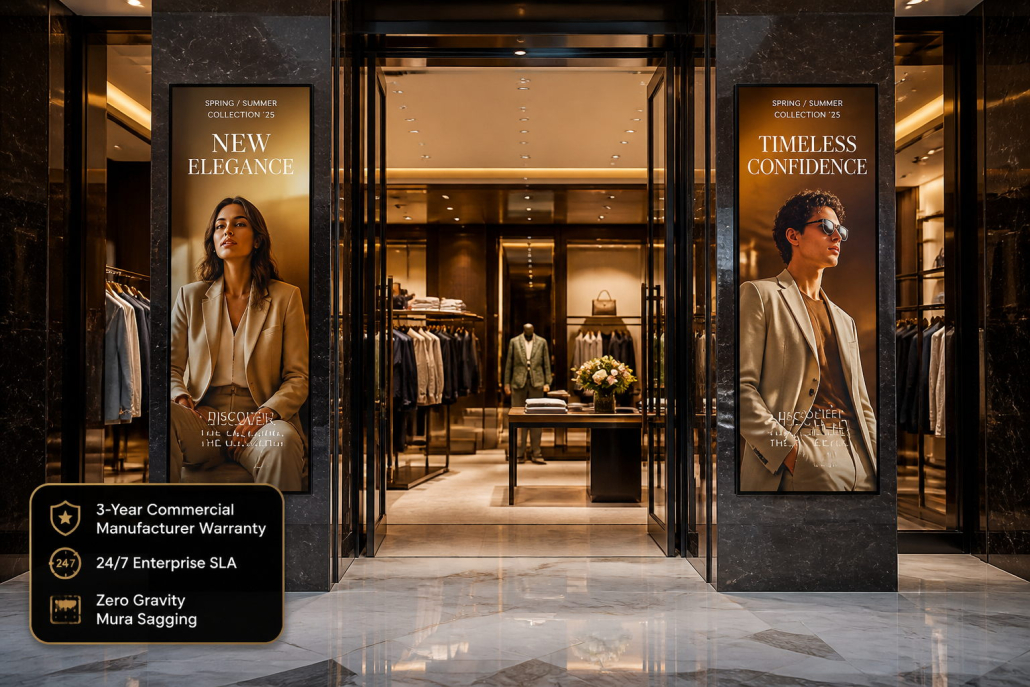
Over 65% of commercial retail signage—such as promotional fashion posters, entrance welcome totems, and directional directories—is installed in Portrait (Vertical) orientation.
Can You Turn a Consumer TV Vertical?
NO. Mounting a consumer TV in portrait mode triggers three immediate failure modes:
- Blocked Thermal Chimneys: Consumer TV internal heat vents are strictly designed for horizontal convection. Turning the screen vertically traps rising heat at the top edge, roasting the main processing board and driver ICs.
- Liquid Crystal Gravity Sagging (“Mura” Effect): In a consumer panel, the internal glass substrate and spacer beads are not engineered to support vertical gravitational shear stress. Over a few months, gravity pulls the liquid crystal fluid downward, creating permanent cloudy black or yellow blotches (known as “gravity mura”) across the lower half of the screen.
- Off-Axis Asymmetrical Viewing Angles: Consumer TVs are optimized for horizontal living room viewing. When flipped 90 degrees, the vertical viewing angle collapses, making the display look dark and inverted to approaching customers.
Kontech Commercial Multi-Orientation Engineering:
- Kontech commercial displays (both wall-mounted and freestanding kiosks) feature reinforced internal panel structures with symmetrical liquid crystal anchor matrices.
- Heat dissipation conduits are bi-directionally optimized, ensuring flawless cooling in both 0° Landscape and 90° Portrait orientations.
Critical Difference 5: The Warranty Trap & Consumer Lockout
The final and most dangerous trap of using consumer TVs is legal and financial:
1. The “Commercial Use” Warranty Void:
Read the fine print of any consumer TV warranty from Samsung, LG, TCL, or Hisense:
“This warranty applies strictly to personal, non-commercial use in a domestic residential setting. Use of this product in a commercial, business, industrial, or institutional environment VOIDS THIS ENTIRE WARRANTY.”
If a consumer TV fails after 3 months in your restaurant, the manufacturer’s technician will inspect the installation. The moment they see it mounted in a retail store, your warranty claim is immediately denied. You absorb 100% of the replacement hardware and labor costs.
In contrast, Kontech commercial displays include a 3-year commercial manufacturer warranty, backed by enterprise-grade SLAs, commercial replacement parts availability, and engineering support.
2. Software Tampering & Consumer Annoyances:
- Keypad & Remote Lockout: Consumer TVs have physical buttons that customers or unruly children can press to change inputs or power off the screen. Kontech displays feature complete firmware-level keypad lockout.
- No Consumer Pop-ups or Ads: Smart TVs frequently display consumer firmware update banners, terms-of-service pop-ups, or unskippable built-in smart TV platform ads over your marketing content. Kontech commercial displays run a clean, unbloated Android 9.0 SoC with hardware watchdogs that boot directly into your cloud CMS in under 30 seconds.
Head-to-Head Technical Specification Matrix
TECHNICAL COMPARISON: PROFESSIONAL COMMERCIAL DISPLAY VS. CONSUMER TV:
┌───────────────────────────┬──────────────────────────┬──────────────────────────┐
│ TECHNICAL SPECIFICATION   │ KONTECH COMMERCIAL DISPLAY│ TYPICAL CONSUMER SMART TV│
├───────────────────────────┼──────────────────────────┼──────────────────────────┤
│ Operating Duty Cycle      │ 24/7/365 Continuous Duty │ 4 to 8 Hours / Day Max   │
│ Screen Luminance (Nits)   │ 700 nits (Indoor)        │ 250 to 350 nits          │
│                           │ 2,000–3,000 nits (Window)│ (Washed out in daylight) │
│ Surface Optical Treatment │ 28% Haze Anti-Glare (AG) │ Glossy Glass (Mirror)    │
│ Operating Temperature     │ -20°C to 50°C (ODF series)│ 10°C to 35°C Residential │
│ Chassis Material          │ Structural Aluminum Metal│ Injection-Molded Plastic │
│ Burn-In Prevention        │ Hardware Pixel-Shift     │ None (High Ghosting Risk)│
│ Mounting Orientation      │ Landscape & Portrait     │ Landscape ONLY           │
│ Backlight MTBF Lifespan   │ ≥50,000 Hours (6+ Years) │ ~15,000 to 20,000 Hours  │
│ Integrated Computing      │ Quad-Core Android SoC    │ Bloated Smart TV OS      │
│ Remote Management         │ Cloud CMS & HW Watchdog  │ Consumer IR Remote Only  │
│ Manufacturer Warranty     │ 3-Year Commercial SLA    │ VOIDED in Commercial Use │
└───────────────────────────┴──────────────────────────┴──────────────────────────┘
The 3-Year Total Cost of Ownership (TCO) Reality
To illustrate the true financial comparison, examine the 3-year Total Cost of Ownership (TCO) for a standard 4-screen restaurant menu board installation:
3-Year TCO Comparison Model (4-Screen QSR Menu Board):
┌──────────────────────────────────────────────┬──────────────────┬─────────────────┐
│ COST COMPONENT OVER 3 YEARS                  │ CONSUMER SMART TV│ KONTECH DISPLAY │
├──────────────────────────────────────────────┼──────────────────┼─────────────────┤
│ Initial Screen Acquisition (4 screens)       │ $1,400 ($350/ea) │ $3,600 ($900/ea)│
│ Initial Installation & Mounting Hardware     │ $800             │ $800            │
│ Premature Failures & Replacements (Year 2-3) │ $2,100 (6 units) │ $0 (Under SLA)  │
│ Emergency Truck Rolls & Electrician Labor    │ $1,200           │ $0              │
│ Revenue Lost to Downtime & Mirror Glare      │ ~$2,500 (Est.)   │ $0              │
├──────────────────────────────────────────────┼──────────────────┼─────────────────┤
│ TOTAL 3-YEAR EXPENDITURE                     │ $8,000           │ $4,400          │
├──────────────────────────────────────────────┴──────────────────┴─────────────────┤
│ VERDICT: COMMERCIAL DISPLAYS SAVE ~45% IN TOTAL 3-YEAR CASH OUTLAYS               │
└───────────────────────────────────────────────────────────────────────────────────┘
*(Figures based on commercial AV failure rate benchmarks in QSR environments).*
While the consumer TV saves $2,200 on day one, it ends up costing nearly double over three years due to repeated hardware failures, unbudgeted technician truck rolls, and tarnished customer brand perception.

