
How Much Electricity Does an Outdoor Digital Signage Consume in a Year?
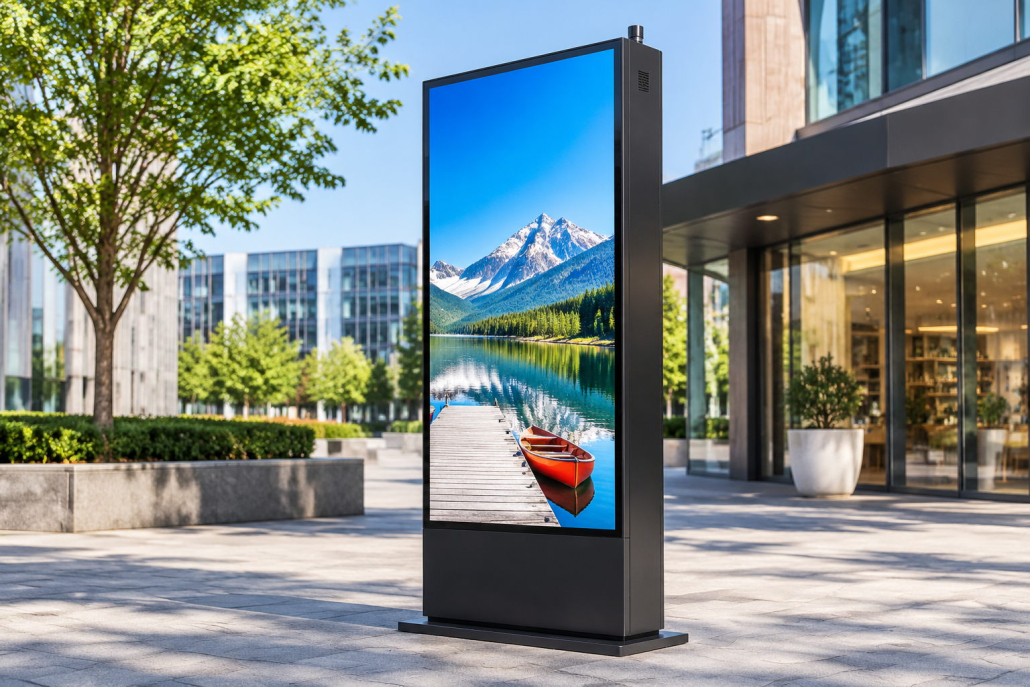
When bidding on or budgeting for an outdoor digital signage network—whether for smart city transit hubs, fast-food drive-thrus, or roadside DOOH (Digital Out-of-Home) advertising—most procurement teams obsess over the initial hardware purchase price (CAPEX).
However, experienced field AV engineers and fleet operators know the hard truth: the cumulative electricity bill (OPEX) over a display’s 5-to-7-year lifecycle frequently eclipses the initial hardware cost.
A standard high-brightness (2,500 to 3,000 nits) outdoor commercial kiosk left running at fixed peak brightness 24/7/365 is not just an eyesore at night; it is an electricity furnace burning thousands of unnecessary dollars every year.
In this engineering guide, we break down the exact physics of outdoor display power consumption, calculate real-world annual kilowatt-hour (kWh) usage across popular screen sizes (55″, 65″, and 75″), and demonstrate how an integrated ambient light sensor probe with intelligent auto-dimming slashes electricity consumption by 40% to 55%.
1. Anatomy of Outdoor Display Power: Where Do the Watts Actually Go?
An outdoor commercial display is fundamentally different from an indoor LCD panel. To calculate electricity consumption accurately, you must understand the three internal subsystems drawing power inside the enclosure:
Outdoor Digital Signage Power Distribution (Peak vs. Weighted Average):
┌────────────────────────────────────────────────────────────────────────┐
│ 1. HIGH-BRIGHTNESS BACKLIGHT ARRAY (60% – 70% of total draw)          │
│    • Direct-lit LED matrix driving 2,500 – 3,500 nits to fight sun.     │
│    • Highly variable: 80W at night vs. 350W under direct midday sun.   │
├────────────────────────────────────────────────────────────────────────┤
│ 2. THERMAL MANAGEMENT & COOLING (15% – 25% of total draw)              │
│    • Variable-speed centrifugal fans or thermal heat exchanger.        │
│    • Modulates based on internal thermal sensors (5W idle vs. 80W max). │
├────────────────────────────────────────────────────────────────────────┤
│ 3. CORE ELECTRONICS & PERIPHERALS (10% – 15% of total draw)            │
│    • Industrial SoC motherboard, media player, 4G/Wi-Fi router, PDU.   │
│    • Relatively constant baseline draw: ~25W – 45W continuous.         │
└────────────────────────────────────────────────────────────────────────┘
A. The High-Power LED Backlight (The Heavy Consumer)
Fighting peak midday ambient sunlight (up to 100,000 lux) requires a robust industrial LED array generating at least 2,500 to 3,000 nits (cd/m²). Driving that optical output through polarizers, liquid crystals, and 6mm anti-reflective tempered glass demands substantial current. At 100% full backlight, a 65-inch outdoor panel draws approximately 300W to 360W on the backlight module alone.
B. The Thermal Management System (Active Cooling)
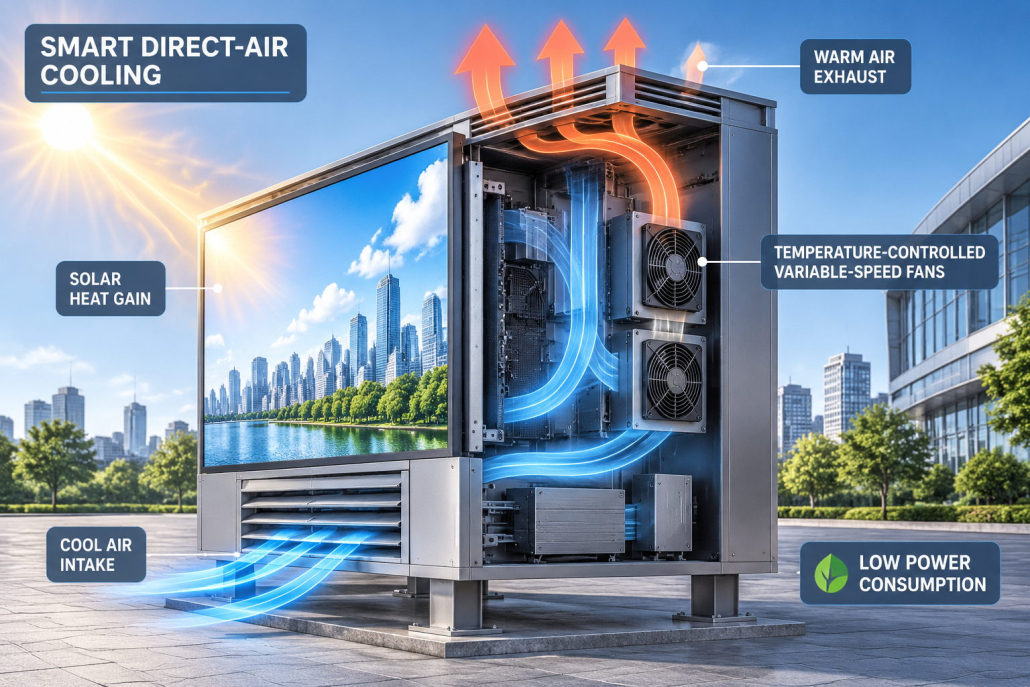
Every watt pumped into the LED backlight generates internal heat, compounded by direct solar radiation (solar heat gain). To prevent the liquid crystals from reaching their isotropic threshold and forming black spots (Mura effect), the display’s internal cooling fans must exhaust heat continuously. Note: Systems engineered with smart direct-air cooling consume a fraction of the electricity required by heavy compressor-based air conditioning units.
C. Embedded Electronics and Industrial Power Supply Losses
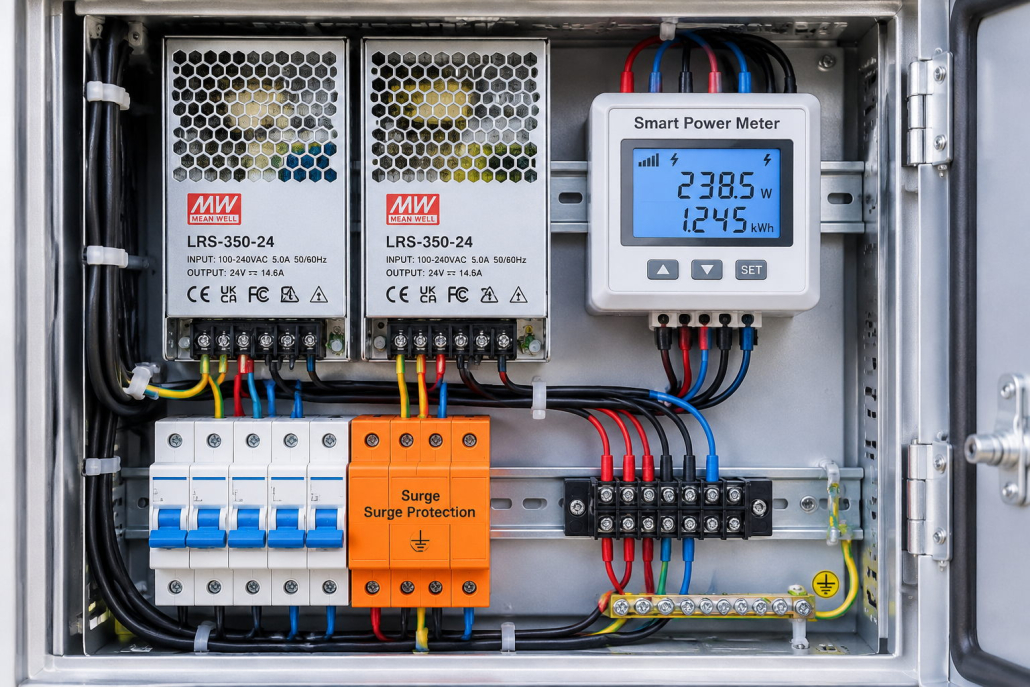
Industrial power supplies (PSUs) convert incoming AC mains (110V/220V) to DC (12V/24V). Premium grade PSUs (such as Mean Well) operate at 88% to 92% electrical efficiency. Budget, unbranded displays using 75% efficiency power supplies waste an extra 15% to 20% of their total power solely as parasitic cabinet heat.
2. The Core Solution: Ambient Light Sensor & Linear Auto-Dimming
The ambient outdoor light level is in perpetual flux. On a clear summer noon, ambient illuminance can exceed 100,000 lux. At dusk, it drops to 500 lux, and at midnight under municipal streetlights, it hovers around 10 to 50 lux.
How the Ambient Light Sensor Probe Operates
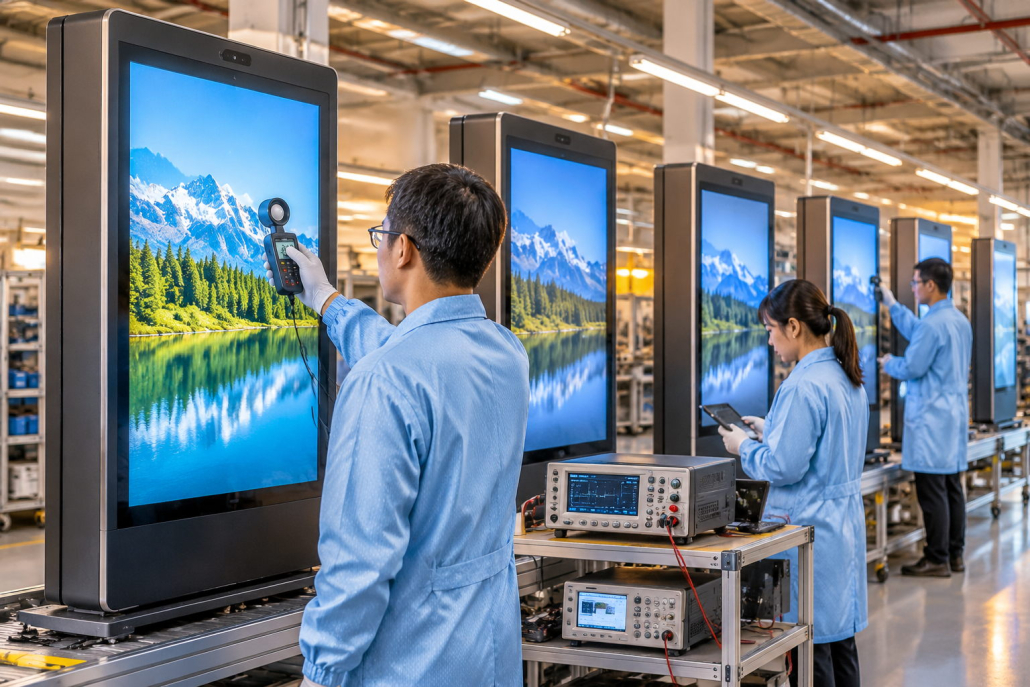
A precision optical photodiode probe is embedded at the top bezel or outer edge of the Kontech outdoor chassis, oriented toward the sky/ambient horizon.
- Sampling & Moving Average Filtering: The sensor samples ambient lux levels continuously. To prevent erratic flickering caused by passing shadows, clouds, or headlights, the microcontroller runs a rolling 30-second moving average algorithm.
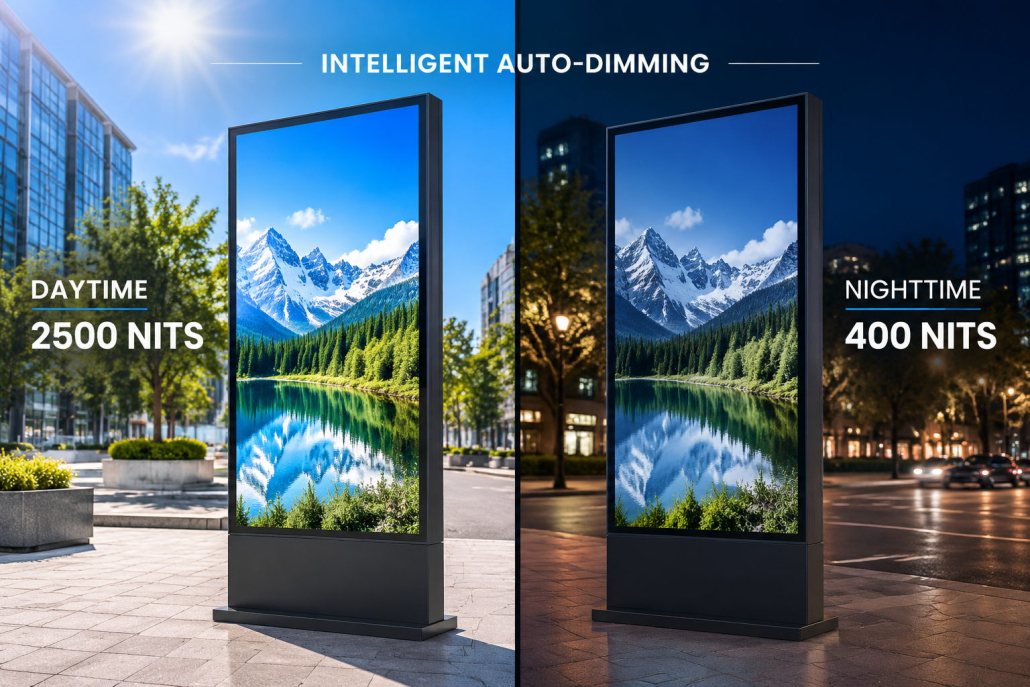
- Stepless Linear PWM Dimming: Rather than crude 2-stage stepping (Day/Night), the system linearly modulates the backlight LED drive current via Pulse Width Modulation (PWM) across 256 micro-steps:
- Full Sun (>60,000 lux): 100% duty cycle → 2,500–3,000 nits (Maximum punch).
- Overcast Day (10,000–30,000 lux): 50%–60% duty cycle → 1,200–1,500 nits (Perfect readability).
- Dusk / Twilight (1,000–5,000 lux): 30% duty cycle → 800 nits.
- Nighttime (<100 lux): 10%–15% duty cycle → 350–450 nits (Comfortable for drivers, zero glare, maximum energy conservation).
24-Hour Solar Cycle vs. Screen Brightness & Power Draw:
Lux Level
100k ──┐                  /───\ (Midday Sun: 2,500 nits / 420W total)
       │                 /     \
 10k ──┼──             /         \
       │              /           \ (Overcast: 1,400 nits / 240W total)
  1k ──┼──           /             \
       │  (Night)   /               \  (Night: 400 nits / 120W total)
    0 ─┴───────────/─────────────────\────────────────────────── Time
       00:00     06:00             18:00                    24:00
Why Nighttime Dimming is Legally & Operationally Essential
Running 2,500 nits in pitch darkness is hazardous. Many municipalities in North America and Western Europe have enacted strict nighttime light-pollution ordinances (e.g., maximum allowable nighttime luminance of 300 to 500 nits). An auto-dimming sensor guarantees legal compliance while automatically capturing massive energy savings.
3. The Math: Real-World Annual kWh & Cost Calculation
To deliver an actionable engineering calculation, we model an outdoor kiosk operating 24 hours per day, 365 days per year in a temperate climate zone, assuming an average daily distribution of 12 daytime operating hours and 12 nighttime operating hours.
Benchmark Comparison: Fixed Peak Brightness vs. Auto-Dimming (65-Inch Display)
Note: Electricity rates vary regionally. US commercial average is ~0.14–0.20/kWh; Western European commercial rates often exceed €0.25–€0.35/kWh.
4. Comprehensive Sizing Chart: 55″, 65″, and 75″ Energy Profiles
Power consumption scales non-linearly with display surface area. Below is the verified engineering reference data for Kontech’s flagship outdoor digital signage product line equipped with intelligent auto-dimming:
Hardware assumptions: Kontech Smart Direct-Air Cooling architecture, ambient temperature range -20°C to +45°C, high-efficiency Class I Mean Well power distribution.
5. Thermal Efficiency: Why Smart Air Cooling Beats Heavy Air Conditioners
In outdoor digital signage, thermal management and electricity consumption are inseparable.
The High Cost of Compressor-Based Air Conditioning
Earlier generations of outdoor kiosks relied on built-in air conditioner (AC) compressor units. A traditional air conditioner compressor pulls an additional 400W to 800W whenever it kicks in.
- Over a year, an air conditioner can easily add 2,000+ kWh of parasitic energy consumption per kiosk.
- In addition, compressors require routine refrigerant inspections and filter maintenance, creating recurring operational expense.
The Kontech Smart Air-Cooling Architecture
Kontech utilizes an engineered positive-pressure direct-air cooling wind tunnel paired with intelligent PWM speed-controlled fans:
- Stepped Thermal Triggers: At internal temperatures below 30°C, the fans spin at a whisper-quiet 20% RPM, drawing less than 10 Watts.
- Dynamic Ramp-Up: As internal temperatures climb during peak solar exposure (35°C–45°C), fan speed smoothly scales up to full CFM throughput (drawing ~45W–60W total).
- High-TNI Liquid Crystal Panels: By using industrial LCD panels capable of withstanding solar surface temperatures up to 105°C/110°C without blackening, the requirement for active sub-ambient refrigeration is completely eliminated, saving upwards of $450 per unit annually in cooling power alone.
6. Engineering Checklist: How to Ensure True Energy-Saving Performance
When specifying outdoor digital signage in tender documents or RFPs, verify these six technical checkpoints to avoid high-electricity traps:
- True Photodiode Probe vs. Software Clock Scheduling: Do not accept software-only “day/night timers.” Cloud-based schedules cannot detect heavy rain, storm clouds, or overcast conditions where dropping brightness to 1,200 nits saves immediate power. Demand a physical, calibrated ambient light sensor probe.
- Mean Well or Equivalent Tier-1 Industrial PSUs: Insist on power supplies certified for >88% conversion efficiency with active Power Factor Correction (PFC ≥0.95).
- High-TNI 105°C Panels: Verify the panel specification sheet guarantees resistance to solar blackening up to 105°C or 110°C.
- Anti-Reflective (AR) Glass Coating: Premium 4mm/6mm tempered AR glass reduces surface reflection from 8% down to <1.5%. Lower surface glare means the display achieves the same perceived legibility at 2,000 nits that raw glass requires 3,000 nits to deliver, saving 25% backlight energy.
- Remote Power Scheduling & Telemetry (RS232 / RJ45): Ensure the display firmware supports deep-sleep sleep schedules (e.g., powering off the display matrix completely between 02:00 AM and 05:00 AM if city transit is closed, keeping only the IoT gateway alive at <3W).
- Factory Burn-In & Calibration: High-quality displays undergo stringent 72-hour optical burn-in tests to calibrate sensor lux-to-PWM response curves before shipping.
 Planning a smart city, transit, or retail DOOH deployment? Contact Kontech’s Technical Engineering Team for detailed power consumption schematics, electrical single-line diagrams, and competitive project pricing.

