
How Much Does a Outdoor digital signage kiosk Cost?
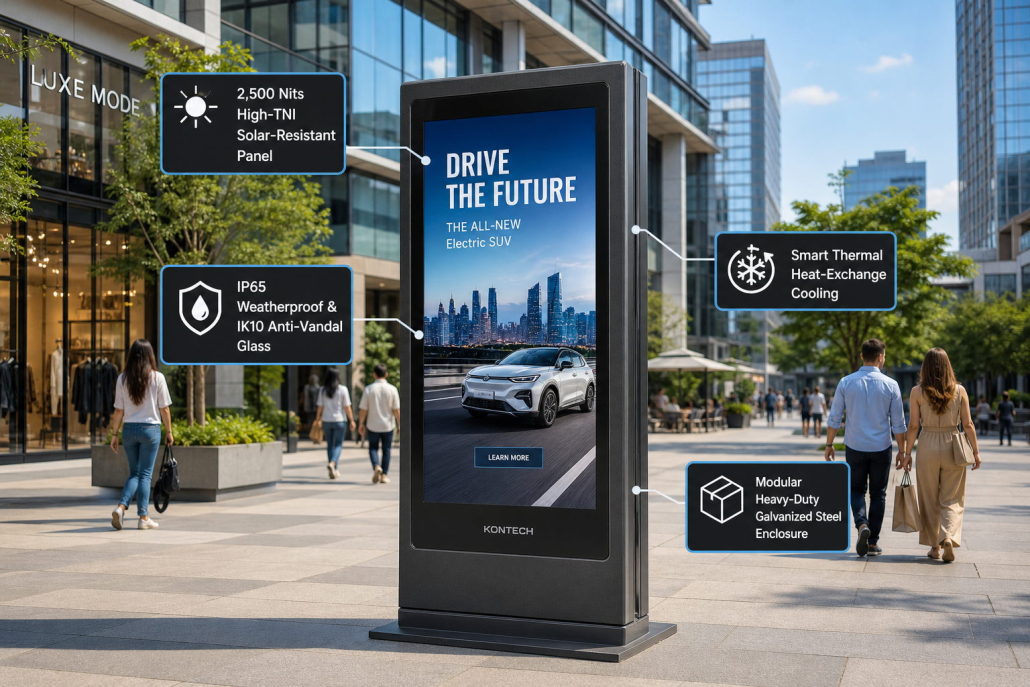
If you have ever requested quotes for a commercial digital display or outdoor advertising kiosk, you have likely experienced sticker shock—or sheer confusion.
One supplier quotes $2,800 for a 55-inch outdoor screen. Another quotes $6,500 for what appears to be the exact same screen size. A third quote for an interactive dual-sided outdoor totem comes in at $12,000.
Why is there such an enormous price gap? Why does a professional outdoor kiosk cost significantly more than an indoor commercial display, let alone a consumer television? And when planning an actual deployment—whether for a shopping mall plaza, a highway rest stop, a transit shelter, or a quick-service restaurant (QSR) drive-thru—what is a realistic budget per unit?
In commercial AV engineering, pricing is not arbitrary. Every dollar between a budget model and an enterprise-grade unit corresponds directly to optical engineering, thermal protection, structural weatherproofing, and expected operating lifespan.
Drawing upon Kontech’s commercial and outdoor display manufacturing standards (ODF outdoor series from 32″ to 75″, IP55 to IP66 weatherproof enclosures, 2,500 to 3,500 nit sunlight-readable panels, and IK10 vandal-resistant glass), this practical guide breaks down:
- Realistic hardware price tiers across screen categories.
- The six critical engineering factors that dictate the final price.
- The “hidden” project expenses (foundation, electrical, freight, and software) needed to calculate your true Total Cost of Ownership (TCO).
Hardware Price Tiers at a Glance (What Displays Actually Cost)
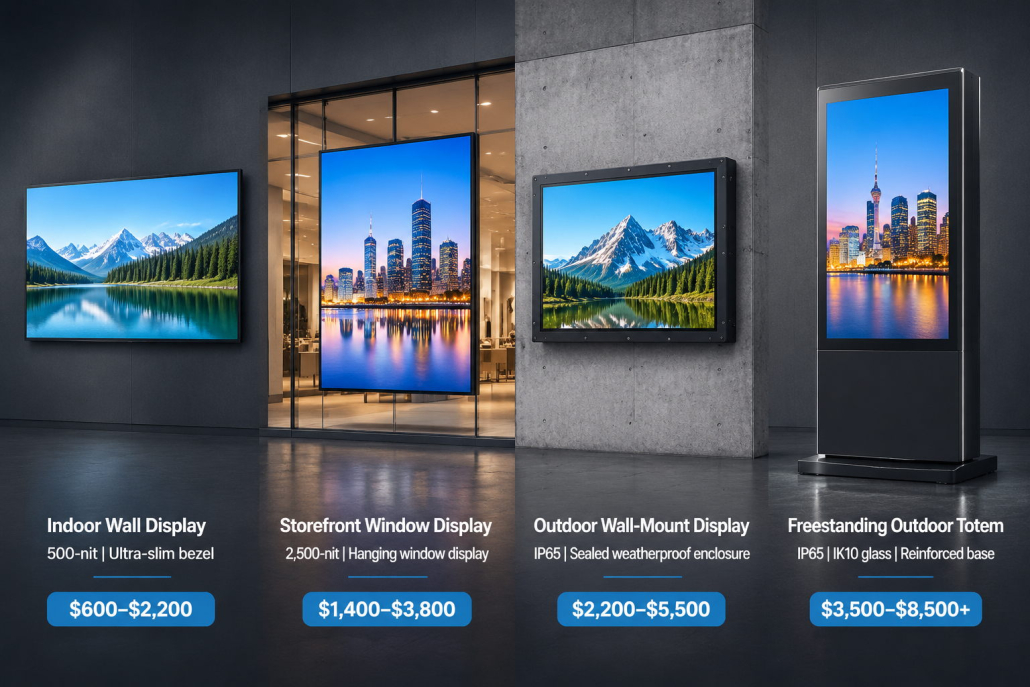
While custom options, order volumes, and freight influence exact commercial pricing, the market generally follows well-defined baseline cost tiers for commercial-grade hardware:
COMMERCIAL DIGITAL DISPLAY PRICING SPECTRUM (INDICATIVE BASELINES):
┌──────────────────────────────────────────────┬──────────────────┬────────────────────────┐
│ PRODUCT CATEGORY                             │ SCREEN SIZE      │ TYPICAL PRICE RANGE    │
├──────────────────────────────────────────────┼──────────────────┼────────────────────────┤
│ Indoor Commercial Display (Wall-Mount)       │ 43" – 65"        │ $600 – $2,200          │
│ • 500–700 nits, non-weatherproof, slim bezel │                  │ (Entry to Enterprise)  │
├──────────────────────────────────────────────┼──────────────────┼────────────────────────┤
│ Storefront Window Display (Semi-Outdoor)     │ 43" – 65"        │ $1,400 – $3,800        │
│ • 2,000–3,000 nits, ambient sensor, indoor   │                  │ (High-brightness LCD)  │
├──────────────────────────────────────────────┼──────────────────┼────────────────────────┤
│ Outdoor Wall-Mounted Display                 │ 32" – 65"        │ $2,200 – $5,500        │
│ • IP55/IP65 sealed, 2,500 nits, IK10 glass   │                  │ (Building facades)     │
├──────────────────────────────────────────────┼──────────────────┼────────────────────────┤
│ Freestanding Outdoor Totem (Single-Sided)    │ 43" – 65"        │ $3,500 – $8,500        │
│ • Complete enclosure, internal HVAC/fans     │ 75" – 85"        │ $7,500 – $12,500       │
├──────────────────────────────────────────────┼──────────────────┼────────────────────────┤
│ Dual-Sided Outdoor Interactive Kiosk         │ 55" – 65"        │ $7,000 – $14,000+      │
│ • Dual 2,500-nit panels, PCAP touch, cameras │                  │ (Wayfinding / Transit) │
└──────────────────────────────────────────────┴──────────────────┴────────────────────────┘
*(Note: Indicative commercial factory pricing. Actual quotes depend on touch features, computing configuration, and volume discounts).*
The 6 Major Price Drivers: What Are You Actually Paying For?
When evaluating two outdoor kiosks that look identical on paper, the price difference almost always traces back to these six core engineering choices:
1. Optical Brightness & High-TNI Panel Technology
A standard indoor television outputs between 250 and 350 nits of brightness. Place it outdoors, and sunlight completely washes it out.
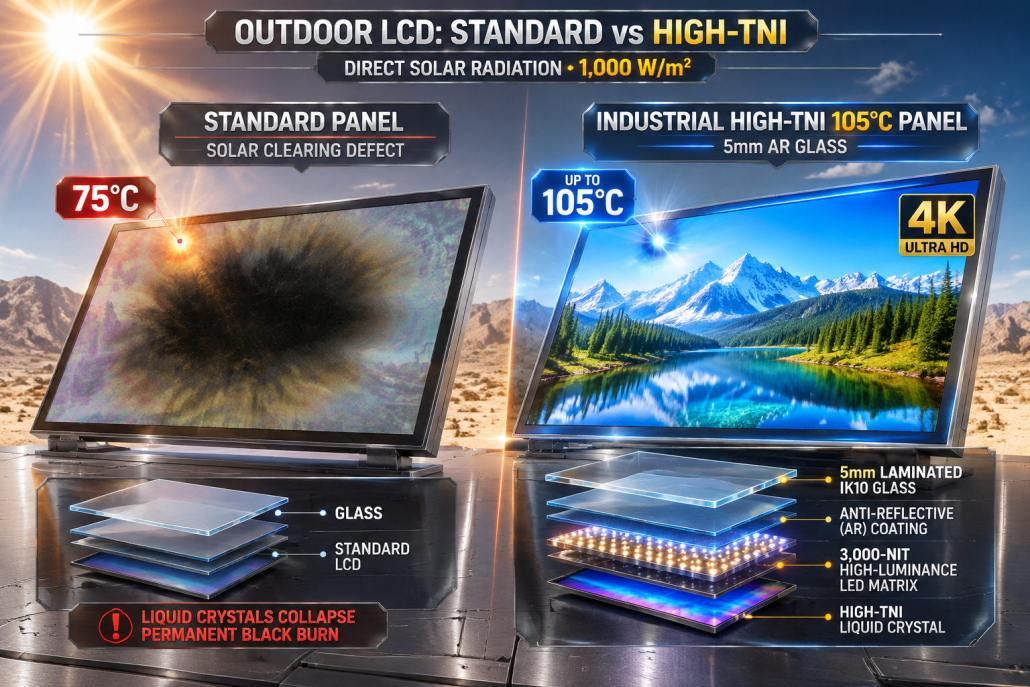
- 2,500 to 3,500 Nits High-Luminance LED Backlights: To remain legible under direct noon sunlight, outdoor displays require dense industrial LED arrays consuming significantly more current and heat.
- High-TNI Liquid Crystal Panels (105°C / 110°C): Standard LCD panels suffer from “solar clearing”—when surface temperatures reach 75°C (167°F) under direct solar radiation, the liquid crystals turn black, creating giant, permanent black blotches. High-TNI industrial panels can withstand surface temperatures above 105°C without discoloration. This specialized panel alone can account for 30% to 40% of total unit cost.
2. Enclosure Ingress Protection (IP55 vs. IP65 / IP66)
- IP55 Enclosures (Entry Outdoor): Protected against dust and low-pressure water sprays. Suitable for covered drive-thrus, under-canopy walkways, and sheltered transit stations.
- IP65 / IP66 Enclosures (Severe Outdoor): Completely dust-tight and sealed against high-pressure water jets and driving monsoon rains. Achieving IP65/IP66 requires continuous closed-cell silicone perimeter gaskets, stainless steel compression latches, and sealed IP68 cable glands, adding $400 to $1,200 to manufacturing costs.
3. Thermal Management: Smart Air Cooling vs. Compressor HVAC
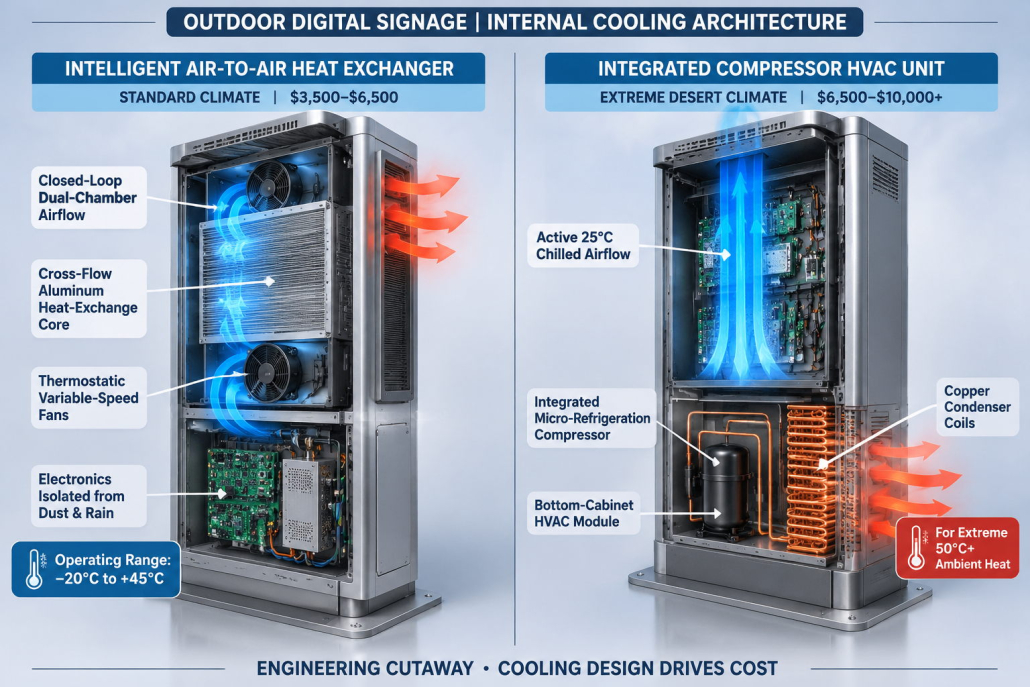
Outdoor kiosks must survive freezing winters (-20°C / -4°F) and scorching desert summers (+50°C / 122°F). How heat is handled drastically shapes cost:
- Intelligent Air-to-Air Heat Exchangers: Dual-loop isolated airflow systems use cross-flow heat exchangers and thermostatically controlled fans. Ambient air never touches internal electronics. This is the most cost-effective method (standard on units priced between $3,500 and $6,500) and handles temperatures up to 45°C.
- Integrated Compressor Air Conditioners (HVAC): For extreme climates (such as the Middle East, Arizona, or tropical industrial zones exceeding 50°C), the kiosk integrates a miniaturized industrial refrigeration compressor. While guaranteeing an internal 25°C operating environment, an HVAC unit adds $1,500 to $3,000 to the initial price and increases ongoing electrical draw.
4. Vandal-Resistant Protection (IK10 Glass & Steel Gauge)
Public outdoor kiosks are exposed to flying gravel, accidental impacts, and deliberate vandalism.
- High-grade outdoor kiosks feature 5mm laminated tempered safety glass rated at IK10 (capable of withstanding a 20-joule impact—equivalent to dropping a 5kg steel ball from a height of 40cm).
- The outer shell is stamped from heavy-gauge galvanized steel or aviation-grade aluminum with electrostatic outdoor powder coating to resist salt spray corrosion. Premium glass and reinforced metal framing add $300 to $800.
5. Touch Interactivity: Non-Touch vs. Optical-Bonded PCAP Touch
- A passive advertising totem simply displays looping video.
- Adding interactive wayfinding or digital ticketing requires Projected Capacitive (PCAP) 10-point touch technology.
- To prevent condensation and maintain responsiveness in rain or when users wear gloves, professional touchscreens require Optical Bonding (vacuum-injecting optical resin between the LCD panel and the front glass). Optical bonding and industrial touch controllers add $800 to $1,800 depending on screen size.
6. Computing & Peripherals (SoC vs. Modular OPS PC)
- Embedded Android SoC (Cost-Effective): Built directly onto the motherboard, drawing just 5W–10W and handling 90% of cloud CMS video playback. (Included in baseline cost).
- Industrial Intel Core i5/i7 OPS Slot-in PC: Required for complex 3D interactive wayfinding, facial analytics, or Windows-based proprietary ticketing software. Adds $450 to $1,200 per unit.
- Add-on Peripherals: Built-in industrial 4G/5G cellular modems, QR/barcode scanners, POS card-reader mounts, and wide-angle security webcams add $200 to $800 per station.
Beyond Hardware: The Total Project Budget (TCO)
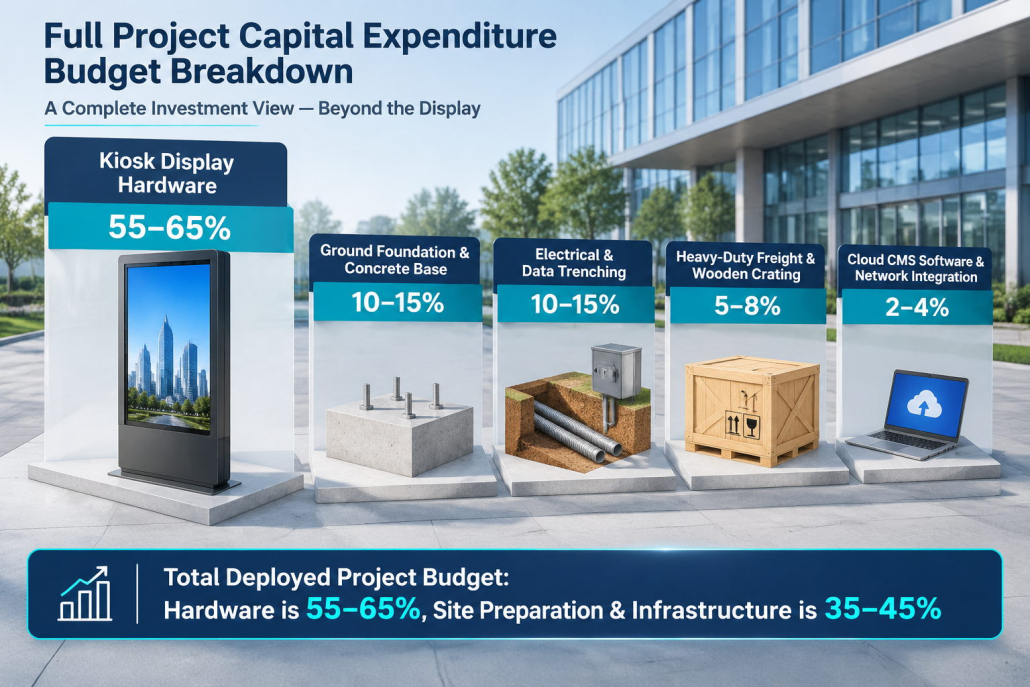
Experienced project managers know that the kiosk hardware invoice is typically only 55% to 65% of the total deployed capital expenditure.
When presenting a complete capital budget to executive leadership or municipal committees, ensure you include these four essential project line items:
REALISTIC FULL-PROJECT CAPITAL EXPENDITURE BREAKDOWN (PER OUTDOOR TOTEM):
┌──────────────────────────────────────────────┬──────────────────┬─────────────────┐
│ BUDGET LINE ITEM                             │ TYPICAL COST     │ PERCENTAGE      │
├──────────────────────────────────────────────┼──────────────────┼─────────────────┤
│ Kiosk Hardware (55" IP65 Outdoor Totem)      │ $4,500 – $6,500  │ 55% – 65%       │
│ Concrete Foundation Pad & Structural Anchors │ $600 – $1,500    │ 10% – 15%       │
│ Electrical Trenching & Conduit Installation  │ $800 – $2,500    │ 10% – 15%       │
│ Heavy-Duty Sea/Air Freight & Wooden Crating  │ $500 – $1,200    │ 5% – 8%         │
│ CMS Software License & Cloud Setup (Annual)  │ $150 – $360      │ 2% – 4%         │
├──────────────────────────────────────────────┼──────────────────┼─────────────────┤
│ ESTIMATED TOTAL DEPLOYED CAPITAL OUTLAY      │ $6,550 – $12,060 │ 100%            │
└──────────────────────────────────────────────┴──────────────────┴─────────────────┘
Ongoing Operating Expenses (OPEX) to Anticipate:
- Electricity Consumption: An outdoor 55-inch 2,500-nit screen averages 350W to 550W during peak daylight and drops to 120W at night. With built-in light sensors, expect $35 to $60 per month in utility costs (at $0.14/kWh).
- Cellular Data (IoT SIM): Using modern CMS differential caching, data consumption is kept to 1GB–3GB/month, totaling $10 to $25 per month.
- Preventive Maintenance: Annual filter cleaning (if air-cooled) or gasket inspections run approximately $150 to $300 per unit annually.
How to Maximize Your Budget: 4 Practical Procurement Tips
- Don’t Over-Specify Thermal Systems: If your displays are installed in moderate climates (rarely exceeding 38°C / 100°F), you do not need expensive, power-hungry compressor air conditioning. High-efficiency heat exchangers and dual-chamber airflow will save you $2,000 upfront and hundreds of dollars annually in electricity.
- Consider Screen Orientation Early: Wall-mounted units eliminate the cost of standalone totem frames and excavation, saving up to 30% on total project costs if a structural building facade is already available.
- Demand Direct OEM/ODM Manufacturing Partnerships: Sourcing directly from qualified commercial display manufacturers (such as Kontech) eliminates two to three tiers of regional AV distributors, middleman markups, and re-branding fees.
- Prioritize Modular Serviceability: Ensure internal power supplies, media players, and cooling fans are modularly accessible via lockable maintenance doors. If a fan or power unit fails in year four, swapping a $60 module in 15 minutes prevents replacing a multi-thousand-dollar kiosk
Get a more detailed quote

