Best brightness for window-facing digital signage
The Window Display Dilemma
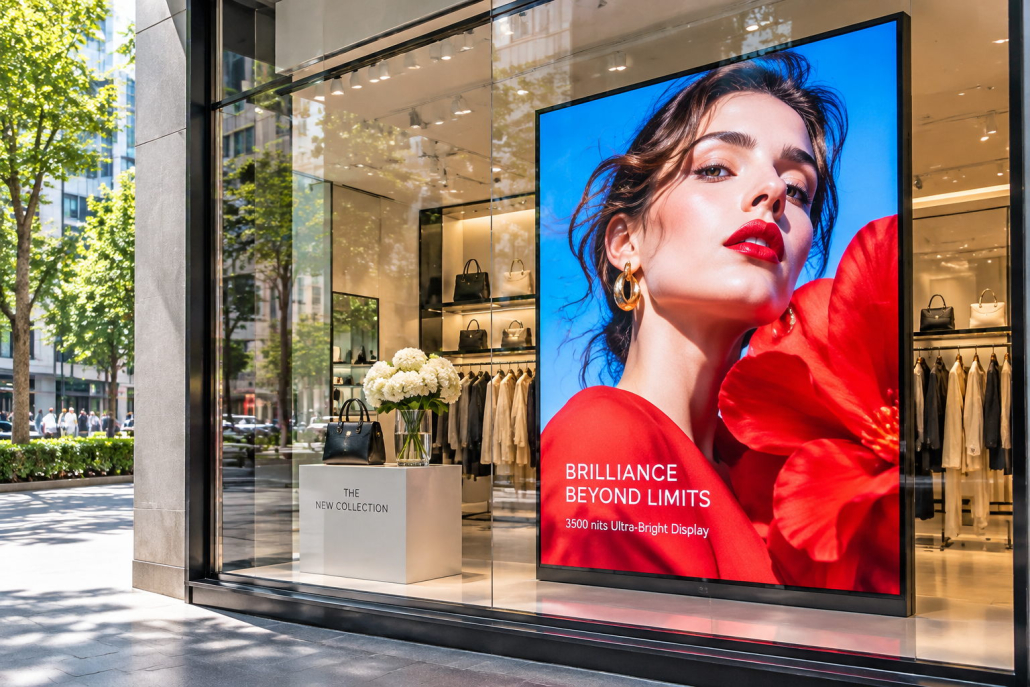
Storefront windows are the most valuable advertising real estate for retail brands, banks, automotive showrooms, and quick-service restaurants (QSR). Installing digital signage behind glass converts passive street foot traffic into active walk-in customers.
However, standard indoor commercial displays and consumer TVs face catastrophic failures when installed in window environments. Store operators frequently encounter two major technical hurdles:
- Unreadable Washed-Out Images & Glare: Strong outdoor ambient light (often exceeding 10,000 to 100,000 lux) combined with double-pane architectural glass reflections turns ordinary screens into dark, reflective mirrors.
- Solar Blackening Defect (Heat Blocs): Direct solar radiation and UV rays penetrate the glass, rapidly heating the LCD panel past its thermal threshold. The liquid crystal molecules lose their orientation, creating unsightly permanent or temporary black blotches across the display.
To safeguard your hardware investment and guarantee high-impact brand visibility 24/7/365, choosing the correct nit brightness, thermal management system, and High-TNI panel technology is critical.
1. What is the Best Brightness for Window-Facing Digital Signage?
Screen brightness is measured in nits (candela per square meter, cd/m2). While indoor office displays require only 250–400 nits and standard commercial video walls operate at 500–700 nits, window-facing environments require a minimum of 2,500 to 4,000 nits.
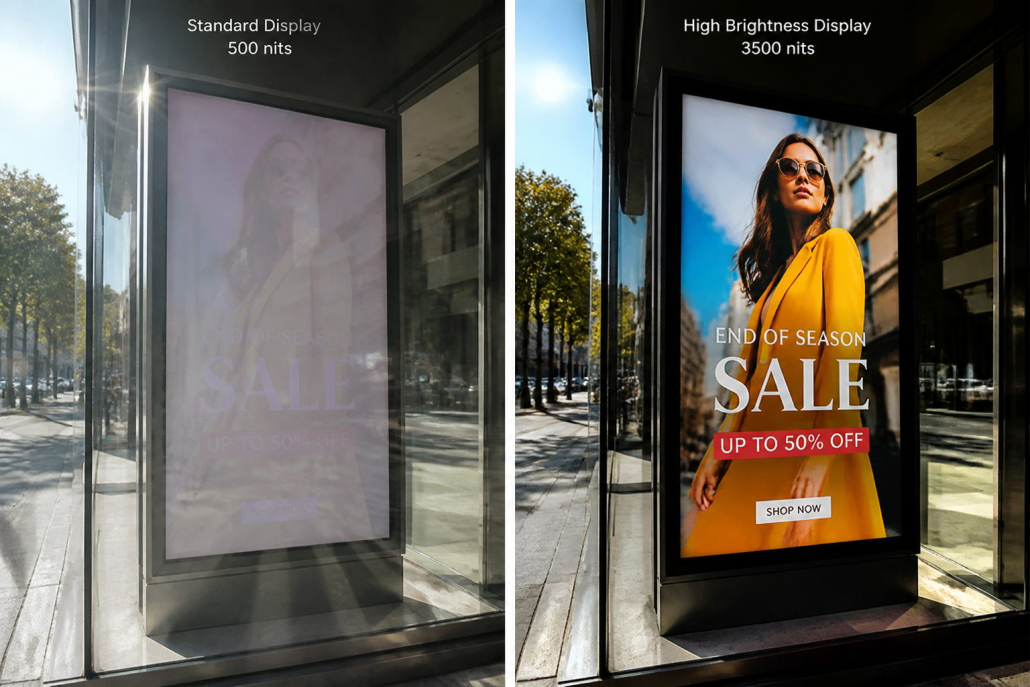
Window Orientation vs. Recommended Brightness Matrix
The precise brightness needed depends strictly on your building’s architectural orientation and sunlight exposure:
Pro Tip: Built-in Smart Ambient Light Sensors
Running a screen at 3,500 nits at night causes painful glare for pedestrians and wastes electricity. Professional window signage must incorporate an intelligent ambient light sensor that automatically modulates brightness from 3,500 nits during blistering midday sun down to 400–600 nits after sunset, cutting power consumption by up to 50% and doubling LED backlight lifespan.
2. Solving the “Blackening Defect”: High-TNI (105∘C/110∘C) Liquid Crystal Technology
The most common fear among procurement managers is the solar blackening defect. Why does it happen, and how is it engineered away?
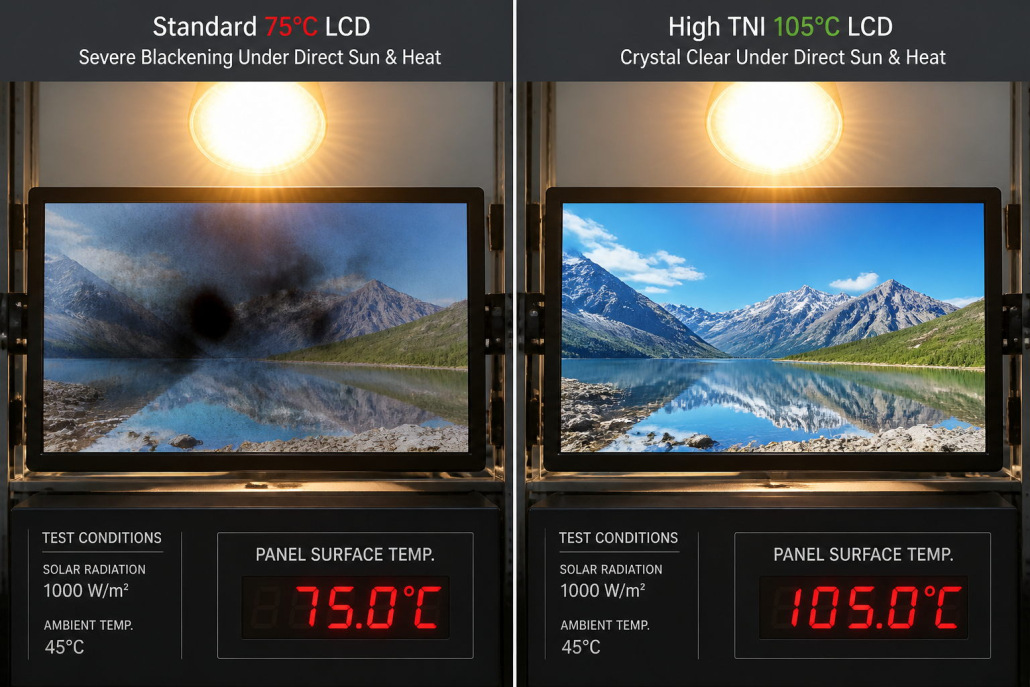
The Science Behind Solar Blackening
Standard liquid crystal molecules have a relatively low Clearing Temperature (Tni)—the critical phase transition point where the liquid crystal shifts from an anisotropic state (orderly molecular arrangement that modulates light) into an isotropic liquid state (complete disorder).
- Standard Commercial / Consumer LCDs: Tni threshold is only 68∘C to 75∘C (154∘F−167∘F).
- The Greenhouse Effect in Windows: Storefront glass acts as a solar heat trap. When solar infrared (IR) and ultraviolet (UV) radiation hit the dark polarizing film of an LCD, surface temperatures easily surge past 85∘C within two hours.
- The Result: The liquid crystal collapses, forming irreversible dark circular spots or total screen blackouts that destroy the display.
The Engineering Solution: High-TNI Industrial Panels
Kontech window-facing digital signage integrates specialized High-TNI liquid crystal cells rated for 105∘C (221∘F) or 110∘C (230∘F).
- Thermal Resilience: Even under scorching summer sun with direct UV and infrared absorption, the liquid crystals remain in an organized nematic phase, completely preventing black blotches.
- Anti-UV Polarizing Film: Specialized optical polarizers block up to 99% of damaging ultraviolet radiation, preventing yellowing and degradation of the TFT matrix over years of continuous exposure.
3. Conquering Window Reflections: Anti-Glare (AG) Glass & Optical Bonding
High brightness alone is not enough if your screen is battling the double reflections of storefront architectural glass and the screen’s own front panel.
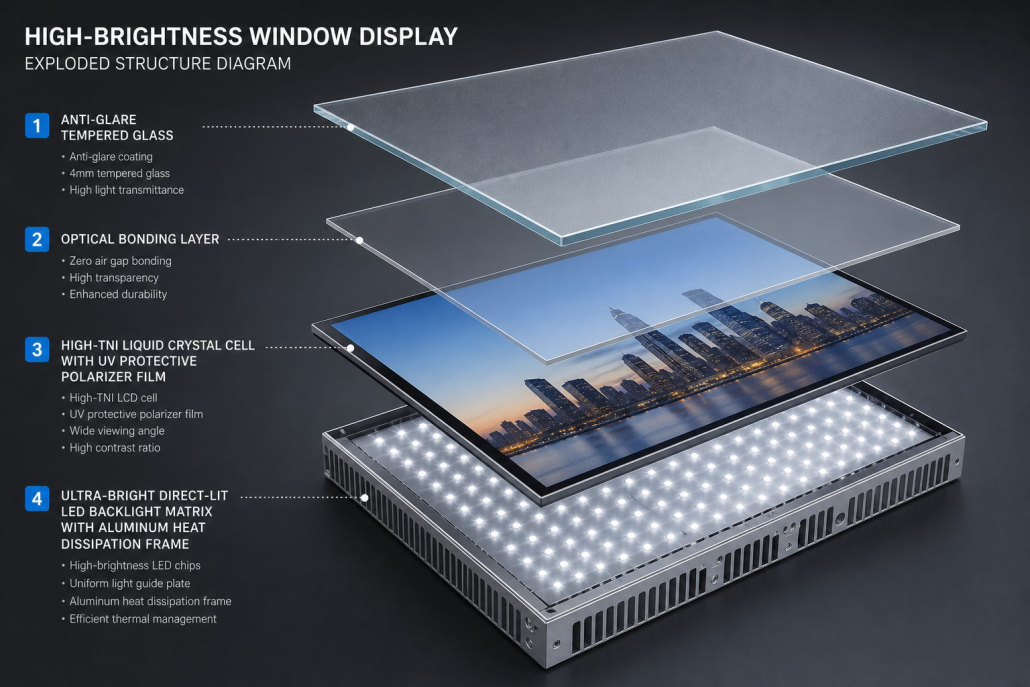
Anti-Glare (AG) vs. Standard Glossy Glass
Standard commercial glass exhibits a surface reflectivity of approximately 4% to 8%, creating harsh specular reflections (mirror effect). Kontech displays employ chemically etched Anti-Glare (AG) tempered glass with haze ratings optimized between 10% and 25%, scattering harsh incident sunlight and keeping graphics legible from wide viewing angles.
Optical Bonding: Eliminating the Internal Air Gap
In conventional screens, an air gap exists between the protective outer glass and the LCD surface. When light travels through air (n≈1.0) into glass (n≈1.5), it undergoes two internal reflections, washing out black levels and reducing effective brightness by 15–20%.
Optical Bonding injects an optical-grade silicone or UV-curable resin (LOCA/OCR) that matches the refractive index of glass:
- Zero Internal Reflection: Eliminates double-image ghosting and internal ambient light scattering.
- Enhanced Contrast Ratio: Delivers deep, inky blacks even under 50,000 lux ambient illumination.
- Thermal Conduction: The bonding resin acts as a thermal bridge, dissipating solar heat directly from the LCD face into the robust aluminum chassis.
- Condensation & Dust Barrier: Completely seals the display against internal fogging, condensation, and dust ingress in humid coastal climates.
4. Thermal Management & 24/7 Continuous Reliability
High-nit LED backlights consume significant power and generate localized heat. Combined with solar heat absorption, inadequate thermal design leads to premature LED backlight decay (yellowing and dimming).
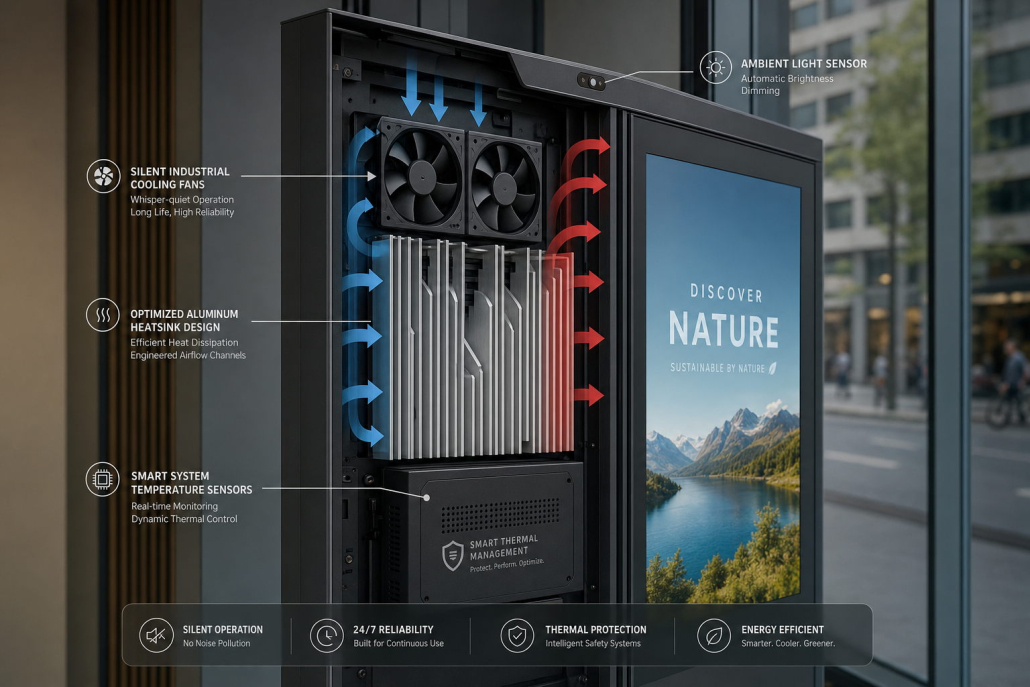
- Quiet Intelligent Cooling Fans: Dual-ball-bearing PWM fans ramp up smoothly based on internal thermistor readings, keeping acoustic noise under 45 dB—essential for luxury boutique environments.
- All-Aluminum Thermal Chassis: Heavy-duty extruded aluminum backplates draw heat away from the high-density LED matrix without adding bulky external air conditioning units.
- Polarized Sunglasses Support (QWP Technology): Incorporates Quarter Wave Plate (QWP) optical retarder film, allowing pedestrians and drivers wearing polarized sunglasses to view landscape and portrait content clearly without blackouts.
5. Technical Specifications Checklist for B2B Buyers
When requesting quotes from OEM/ODM manufacturers, ensure your project specification sheet includes the following baseline technical parameters:
Frequently Asked Questions (FAQ)
Q1: Can I just use a high-brightness TV (like a 1,500-nit consumer TV) in my shop window?
A: No. Consumer TVs lack High-TNI liquid crystal panels (they use standard 70∘C panels) and will quickly suffer from permanent solar blackening defects under direct sun. Furthermore, consumer TVs are rated only for 6–8 hours of daily use and lack anti-glare glass, optical bonding, and commercial thermal fans, leading to premature backlight burnout within months.
Q2: Is 2,500 nits enough for all window displays?
A: 2,500 nits is ideal for north-facing windows or storefronts covered by outdoor awnings/arcades. However, for south-facing and west-facing windows exposed to direct, unshaded sunlight between 11:00 AM and 4:00 PM, a 3,500 to 4,000 nit display with a High-TNI panel is required to guarantee contrast and prevent solar overheating.
Q3: Does high brightness consume too much electricity?
A: While operating at full 3,500 nits consumes approximately 250W–450W (depending on screen size from 43″ to 75″), professional displays with built-in ambient light sensors operate at full brightness for only 4–6 peak hours per day. During cloudy days and nighttime, the system automatically drops to 500 nits, reducing average 24-hour power consumption by more than 40%.
Why Choose Kontech for Window-Facing Signage?
As a specialized B2B commercial display manufacturer with over 15 years of OEM/ODM engineering excellence, Kontech provides complete window digital signage solutions ranging from 32″ to 86″:
- Ultra-slim dual-sided and single-sided window hanging displays
- Custom High-TNI 105∘C commercial panels with optical bonding
- Built-in Android / Windows commercial media players and CMS support
- CE, FCC, RoHS, UL-certified reliability for global rollouts
Ready to upgrade your storefront? Contact Kontech’s Engineering Team today for custom project specs, photometric simulation, and competitive B2B wholesale pricing.
