
Best Digital Signage Solutions for Bubble Tea Shops: The Modern Visual Merchandising Guide
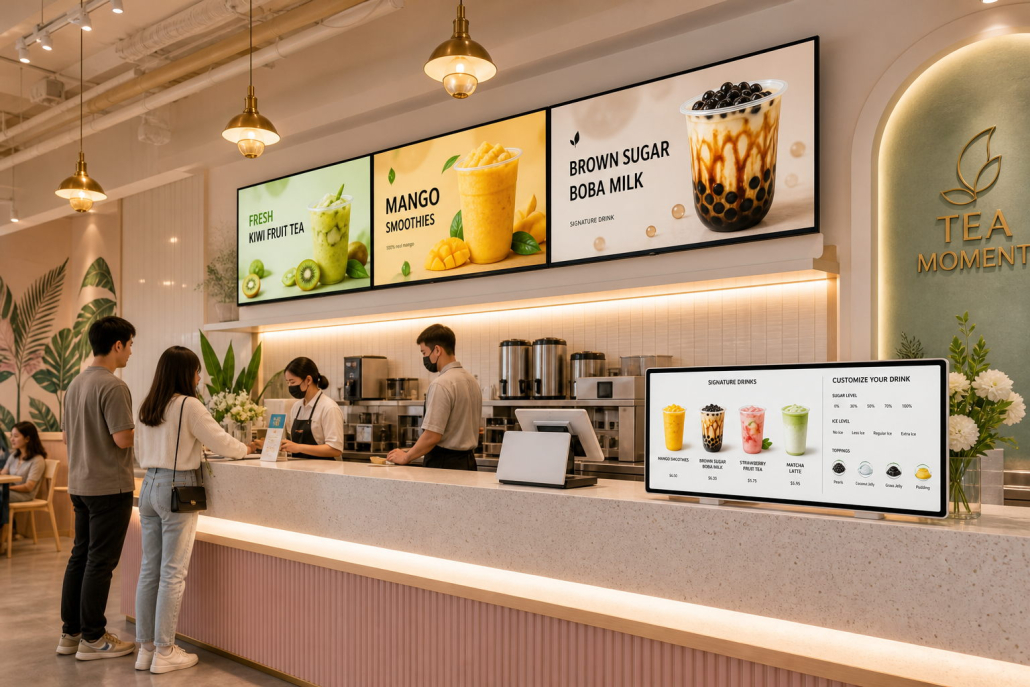
The global bubble tea (boba) industry has evolved from a niche Asian beverage into a multi-billion-dollar global cultural sensation. With thousands of vibrant stores opening across North America, Europe, Australia, and Southeast Asia, competition for consumer attention has never been fiercer.
In this fast-paced beverage retail environment, your ordering counter and storefront window represent your most valuable sales real estate. Yet, bubble tea and specialty beverage shops face operational and visual challenges unique to their craft:
- Complex Menu Customization Matrices: Unlike standard fast food, boba orders require multi-step customization—sweetness levels (0%, 30%, 50%, 70%, 100%), ice levels, dairy alternatives, and a dozen toppings (tapioca pearls, popping boba, cheese foam, pudding, grass jelly, aloe vera). Static printed menus quickly become cluttered, confusing, and unreadable.
- Hyper-Seasonal Product Cycles: Boba culture thrives on limited-time offerings (LTOs)—summer mango pomelo sago, autumn spiced pumpkin milk tea, winter warm brown sugar mochi, and spring sakura lychee. Printing and shipping physical menus every six weeks generates massive operational friction and recurring printing waste.
- High-Velocity Queue Pressures: Peak boba store traffic concentrates during afternoon tea breaks and evening outings. If customers cannot comprehend the menu within 10 to 15 seconds of joining the line, order times slow down, lines spill out, and impatient shoppers walk away.
- Aesthetic Brand Expectations: Today’s Gen Z and millennial boba enthusiasts expect photogenic, stylish store environments. Faded paper posters, handwritten chalkboards, or bulky black office monitors damage the brand’s premium appeal.
To solve these challenges, leading beverage brands are turning to specialized commercial digital signage. In this comprehensive guide, we examine the best digital display configurations for bubble tea shops, featuring factory-direct hardware engineering from Kontech—a commercial display manufacturer with 17+ years of ODM/OEM experience and specialized milk tea desktop display technology.
1. The Core Bubble Tea Digital Signage Portfolio
Modern bubble tea stores operate within compact, high-rent footprints. Hardware must be visually sleek, space-efficient, and engineered to cut through bright store lighting. Kontech provides five tailored display solutions specifically engineered for tea and beverage retail:
Bubble Tea Storefront Digital Touchpoints:
┌─────────────────────────────────────────────────────────────────────────┐
│                     CENTRAL CLOUD CMS (Wi-Fi / LAN)                     │
└──────┬─────────────────────┬───────────────────┬───────────────────┬────┘
       │                     │                   │                   │
       ▼                     ▼                   ▼                   ▼
[1. WINDOW DISPLAY]   [2. OVERHEAD ARRAY]  [3. 21:9 DESKTOP]  [4. SELF-ORDER]
• 32" to 86"          • 43" to 55" 4K      • 29" Ultrawide     • 32" to 43"
• 2,000–3,000 Nits    • 700 Nits 24/7      • 700 Nits / White  • 10-Point Touch
• Foot Traffic Hook   • Master Category    • POS Cashier Addon • Customization
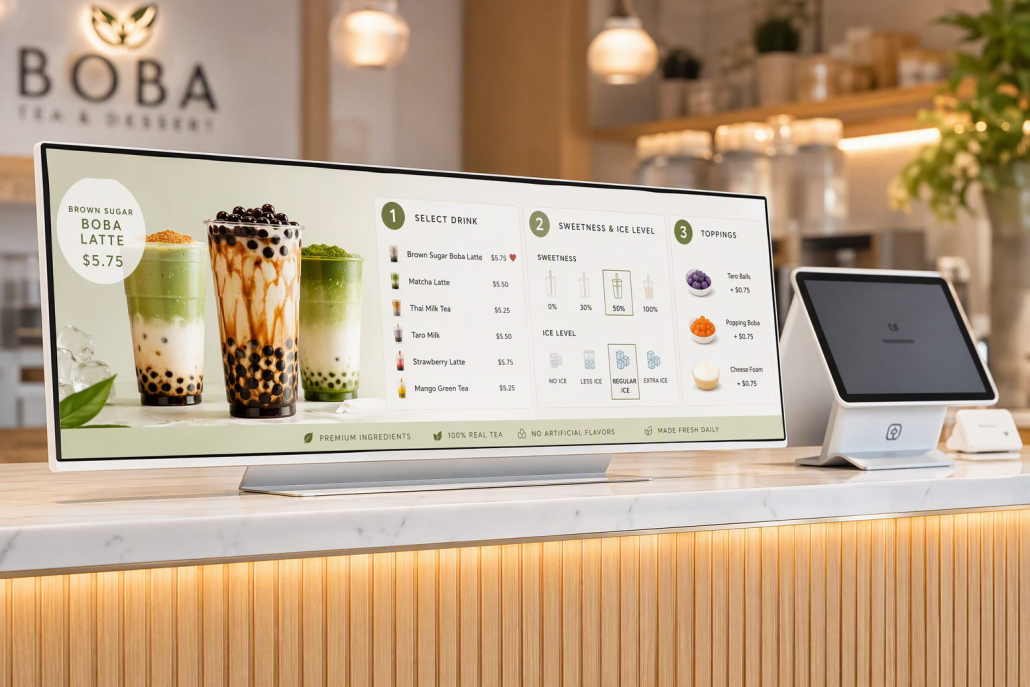
A. The 29-Inch Ultrawide (21:9) Desktop Digital Menu Board
- Deployment Location: Directly on the main cashier counter, pickup shelf, or pastry display case.
- Verified Kontech Specifications:
- Screen Size & Aspect Ratio: 29-inch BOE TFT-LCD panel featuring an ultrawide 21:9 stretched panoramic format (Active Area: 672.8 × 283.8 mm; Physical Resolution: 2560×1080 2K).
- Commercial Brightness: 700 cd/m² (700 nits) with 1200:1 high contrast ratio—completely impervious to counter spotlights.
- Boutique Aesthetics: Elegant glossy milky-white metal housing with an ultra-thin 1mm bezel, measuring just 686.2 × 307.6 × 33.8 mm and weighing only 6.5 kg.
- Embedded System & Connectivity: Integrated Android OS powered by an RK3288 Cortex-A17 processor, 2GB RAM, 8GB ROM, dual USB, Ethernet RJ45, TF card slot, 2.4G Wi-Fi, and Bluetooth support.
- Energy Efficiency: Maximum power consumption under 45W (standby <1W), powered by safe DC 12V input.
- Duty Cycle: Engineered for 7×24 hours uninterrupted continuous playback with a 50,000-hour backlight lifespan.
- Operational Value: The 21:9 stretched bar format is an architectural match for narrow boba service counters. It sits comfortably at eye level right next to the POS register, allowing cashiers to highlight signature drinks, sweetness/topping selection guides, and impulse upsells without obstructing customer-staff eye contact.
B. Standard 23.8-Inch Tabletop Menu Displays
- Deployment Location: Cash wrap counters, self-service straw/napkin stations, and order pickup windows.
- Verified Kontech Specifications: 23.8-inch IPS panel, 16:9 aspect ratio, 1920×1080 Full HD, 700 cd/m² brightness, 1000:1 contrast ratio, 1mm ultra-thin border, sheet metal casing in clean white finish, Android 9.0 OS, dual stereo speakers (2×4W), total power consumption under 35W.
- Operational Value: Compact and portable (4.4 kg), providing a dedicated dynamic canvas for loyalty program QR codes, daily specials, and gift card promotions.
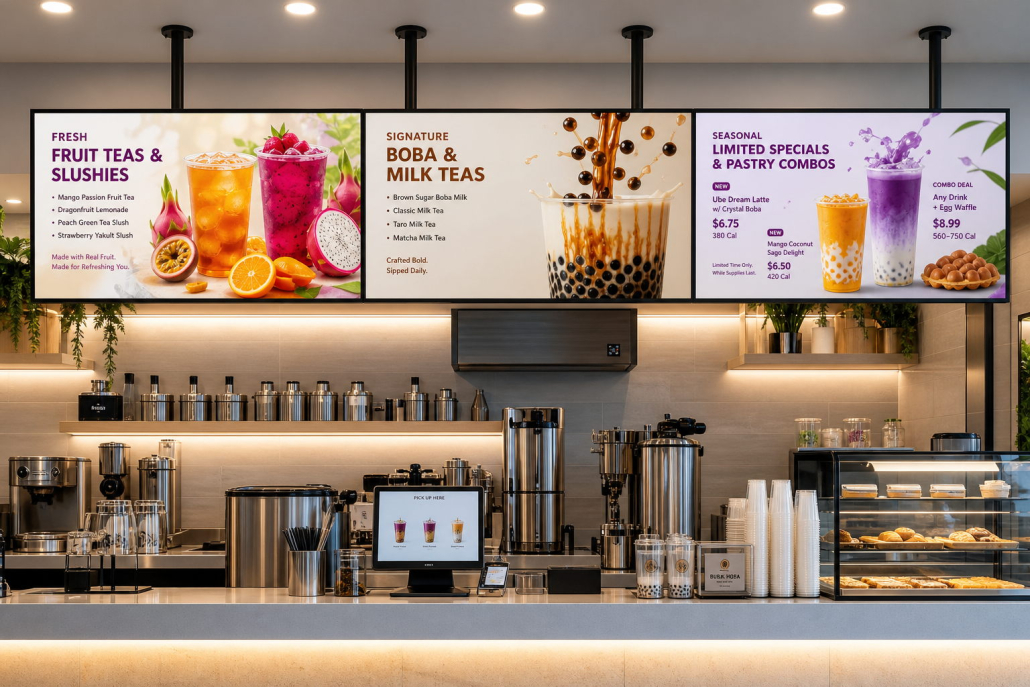
C. Overhead High-Brightness Multi-Screen Arrays (43″ to 55″, 700 Nits)
- Deployment Location: Ceiling-hung or wall-mounted horizontally above the boba preparation counter.
- Verified Specifications: 43″, 49″, and 55″ 4K Ultra HD (3840×2160) commercial panels, 700 nits brightness, ultra-narrow aluminum bezels, 178°/178° all-angle viewing, landscape and portrait orientation support.
- Operational Value: A multi-screen array (typically 3 to 4 screens) serves as the primary menu engine. Screen 1 showcases Fruit Teas & Smoothies; Screen 2 features Classic Milk Teas & Brown Sugar Series; Screen 3 presents Seasonal LTOs & Combo Specials. 700 nits of calibrated luminance ensures text and vibrant drink photography remain punchy under harsh store spotlights without glare.
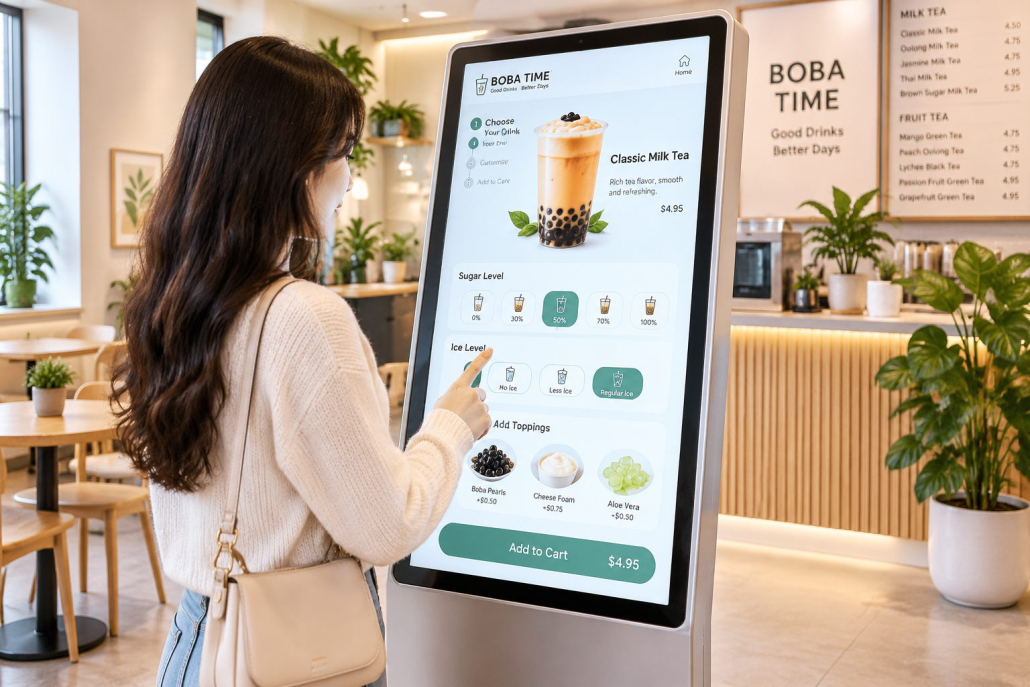
D. Interactive Self-Ordering Touch Kiosks (32″ to 43″)
- Deployment Location: Entrance lobby and ordering queue area.
- Verified Specifications: 10-point PCAP capacitive touch screen, 3–5mm tempered protective glass, integrated barcode/QR code scanners and card payment brackets, Android or Windows OS.
- Operational Value: Self-ordering kiosks revolutionize the boba ordering experience by providing an intuitive visual interface for multi-step customization. Customers can tap to add extra boba, choose exact sugar/ice percentages, and explore pictures of exotic toppings. Industry case studies indicate that self-ordering kiosks consistently increase average ticket size by 15% to 22% through automated add-on recommendations.
E. High-Brightness Window Advertising Displays (43″ to 65″, 2,000 to 3,000 Nits)
- Deployment Location: Suspended behind the storefront glass window facing outdoor pedestrian foot traffic.
- Verified Specifications: 2,000 to 3,000 nits daylight-readable commercial panels, High-TNI liquid crystal technology resisting direct sunlight temperatures up to 110°C without blackening defects, built-in ambient light sensor for automatic evening dimming.
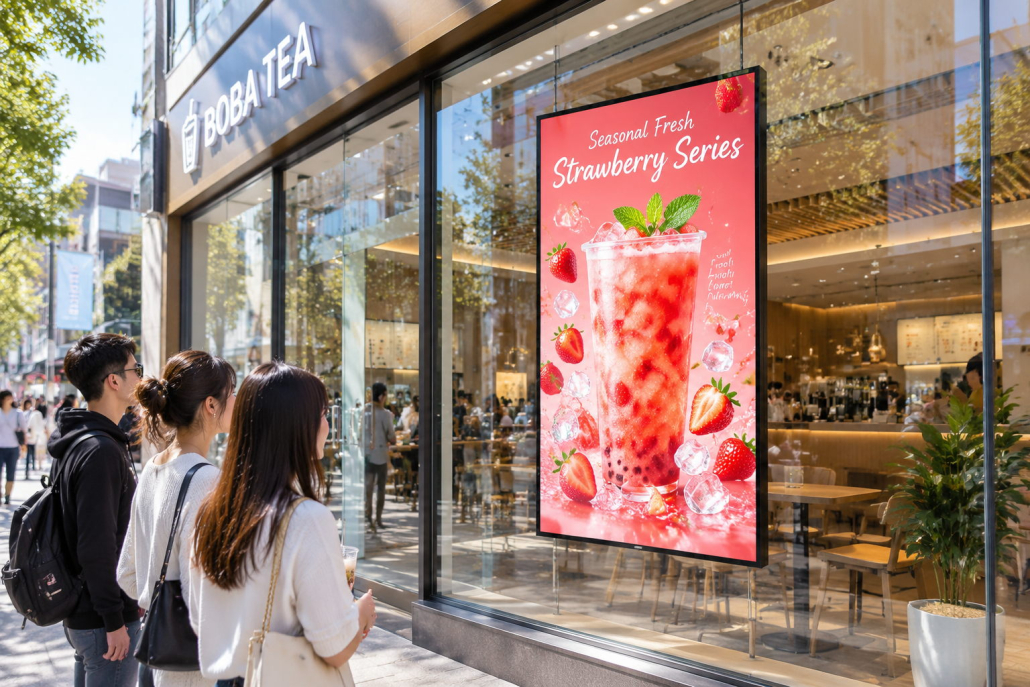
- Operational Value: Cuts through midday glass reflections and sun glare, broadcasting mouth-watering 4K video clips of refreshing fruit teas and cascading boba pearls to stop sidewalk pedestrians and drive foot traffic inside.
2. Multi-Store Cloud CMS: Centralized Control for Growing Beverage Chains
For growing bubble tea franchises expanding from 3 stores to 300 locations, manual menu updates are an operational impossibility. Kontech digital menu boards connect directly via Wi-Fi or Ethernet to cloud-based Content Management Systems (CMS):
Feature 1: Instant LTO & Seasonal Menu Rollouts
When launching a limited-time beverage (e.g., Seasonal Fresh Strawberry Cheese Foam):
- The central marketing team uploads high-resolution 4K video assets and menu pricing to the cloud CMS dashboard.
- With a single click, the campaign deploys simultaneously across every franchise store globally in seconds, ensuring 100% brand consistency.
Feature 2: Real-Time Out-of-Stock (“86”) Management
Boba stores frequently run out of perishable fresh ingredients (such as fresh mangoes, boba pearls during midday boiling, or oat milk):
- Store managers can access the cloud CMS via a smartphone app or web browser to temporarily mark specific toppings or drinks as “Sold Out”.
- The item immediately grays out or updates on overhead and desktop screens, eliminating customer confusion and awkward cashier apologies.
Feature 3: Dynamic Temperature-Based Content Scheduling
- On hot summer afternoons (above 85°F/30°C), the CMS automatically promotes refreshing iced fruit teas, passion fruit slushies, and lemon coolers.
- During chilly winter days, the displays shift dynamically to promote hot brown sugar ginger tea, warm taro milk, and comforting matcha lattes.
3. Commercial Display vs. Consumer TV: Why Home TVs Fail in Boba Shops
4. B2B Menu Engineering Tips for Bubble Tea Displays
To maximize return on investment (ROI) from digital menu boards, leading beverage brands implement proven menu engineering principles:
- The Golden Triangle Rule: Place your highest-margin signature drinks (such as Brown Sugar Boba Milk and Signature Fruit Teas) in the top-center or upper-right quadrant of the primary overhead screen, where customer eyes naturally gravitate first.
- Video Motion on High-Margin Items: Human eyes are neurologically wired to track motion. Use subtle motion loops—such as boba pearls dropping into milk or fruit slices splashing into iced tea—specifically on your top-tier profit drivers to increase their selection rate by up to 30%.
- Dedicated Customization Legend: Allocate one dedicated screen section or desktop display solely to the “Build Your Own Cup” 3-step guide: (1) Choose Base Tea ➔ (2) Select Sweetness & Ice ➔ (3) Pick Toppings. A clear visual guide speeds up decision-making and eliminates line bottlenecks.

