
Which Brightness Is Right for Your Project?
High brightness displays are widely used in retail stores, shopping malls, restaurants, transportation hubs, outdoor advertising, and other commercial environments where standard displays may be difficult to see clearly. With higher screen brightness, these displays help businesses deliver visible, engaging digital content in bright indoor spaces and challenging outdoor conditions.
But what exactly is a high brightness display? How bright does a screen need to be for a particular application? And how can B2B buyers choose the right high brightness LCD display for their projects?
In this guide, we explain how high brightness displays work, their key benefits, common applications, and the factors to consider when sourcing commercial displays from a manufacturer.
What Is a High Brightness Display?
A high brightness display is a screen designed to deliver higher luminance than a conventional display, making content easier to see in environments with strong ambient light.
Screen brightness is typically measured in nits, also known as candelas per square meter (cd/m²). A higher nit value generally means the screen can produce more visible light, helping images, text, and videos remain clear under bright lighting conditions.
For example, a standard indoor monitor may provide around 250–350 nits, while commercial high brightness displays may offer 500, 700, 1,000, 1,500 nits or more, depending on the application and product design.
There is no single brightness level that defines every high brightness display. The appropriate specification depends on the installation environment, ambient light, viewing distance, screen orientation, and whether the display is exposed to direct sunlight.
For B2B buyers, selecting the right brightness level is essential for balancing visibility, energy consumption, thermal management, and total cost of ownership.
How Bright Should a High Brightness Display Be?
The ideal brightness depends on where the display will be installed. The following ranges are general purchasing guidelines rather than universal standards.
| Application | Typical Brightness Range | Key Consideration |
|---|---|---|
| Standard indoor commercial displays | 250–500 nits | Controlled indoor lighting |
| Indoor high brightness digital signage | 500–700 nits | Bright retail and commercial interiors |
| Semi-outdoor window displays | 700–1,500 nits | Strong daylight behind or around the screen |
| Outdoor digital signage | 1,000–2,500+ nits | Ambient sunlight, weather and heat |
| Direct-sunlight applications | Often 1,500–2,500+ nits | Screen orientation, reflections and sunlight exposure |
These ranges are indicative only. Actual requirements vary by location, panel technology, optical bonding, anti-reflection treatment, and installation design. A high-nit screen alone does not guarantee sunlight readability.
1. Indoor High Brightness Displays
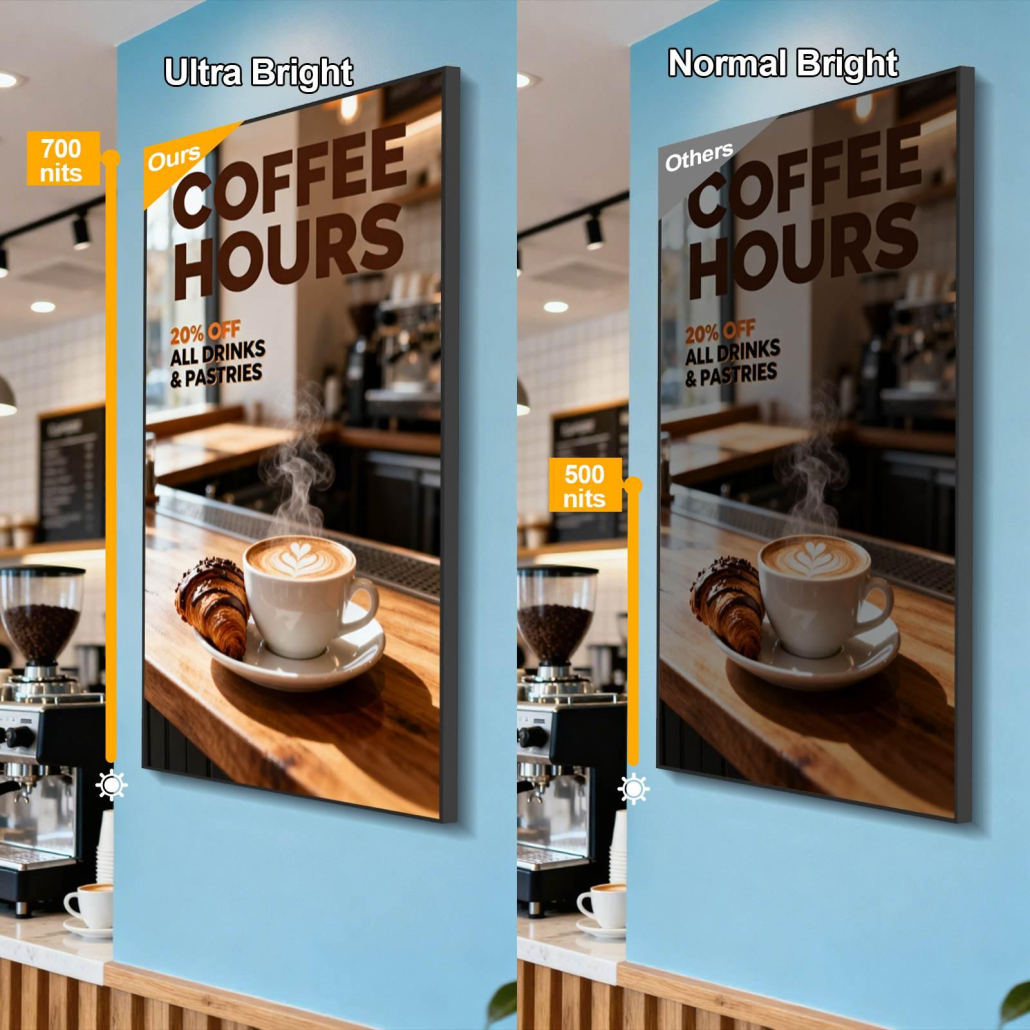
Indoor high brightness displays are suitable for retail stores, shopping malls, restaurants, corporate buildings, showrooms, and other commercial spaces with strong ambient lighting.
Compared with standard monitors, they can improve content visibility in bright storefronts and high-traffic areas.
Common applications include:
- Indoor digital signage
- Digital menu boards
- Retail promotional displays
- Shopping mall advertising screens
- Commercial information displays
2. High Brightness Window Displays
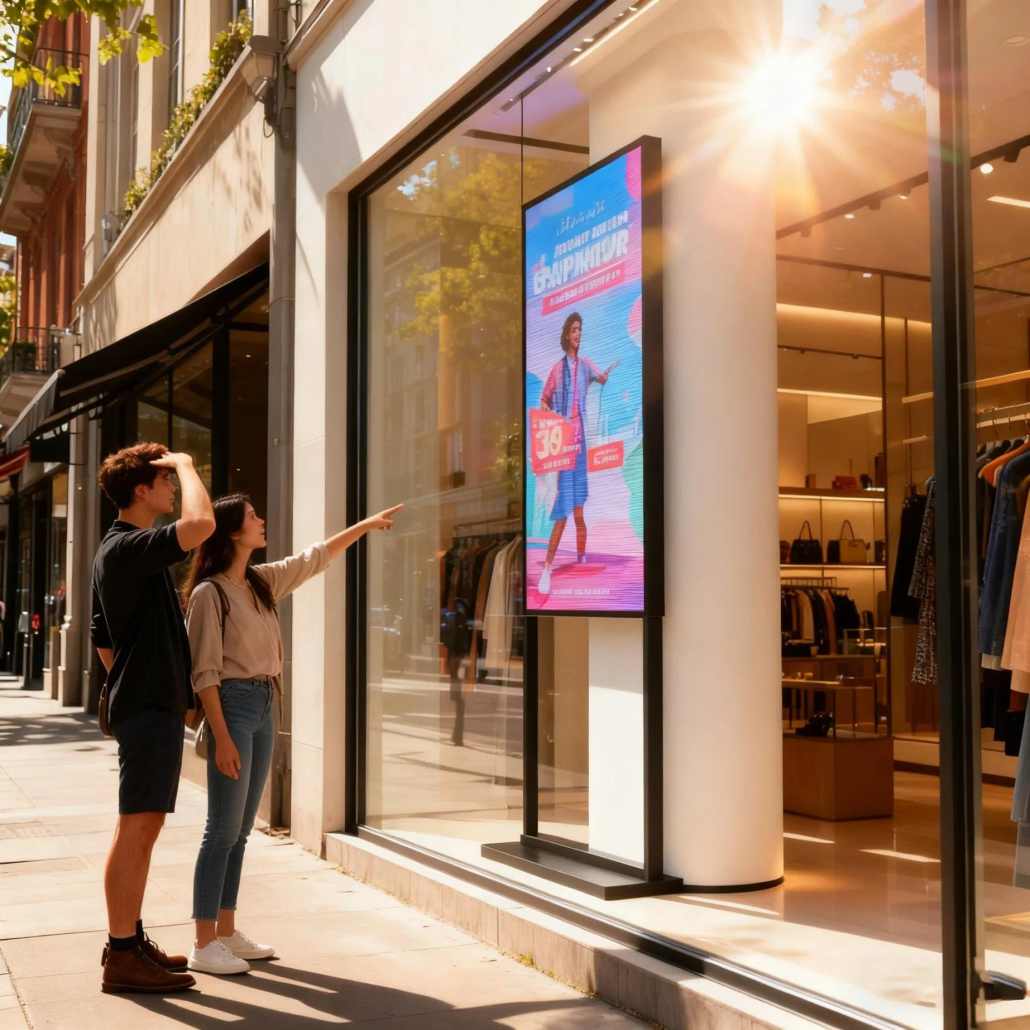
High brightness window displays are designed for shop windows and other locations where sunlight can make ordinary screens difficult to read.
They are particularly useful for retailers that want to display promotions, product videos, brand messages, and campaign content to pedestrians outside their stores.
Depending on the installation, buyers may consider:
- Brightness suitable for the expected daylight conditions
- Anti-glare or anti-reflection performance
- Slim design and narrow bezels
- Portrait or landscape orientation
- Single-sided or double-sided viewing
- Floor-standing, wall-mounted, or suspended installation
- Automatic brightness adjustment
For double-sided window displays, the brightness and optical specifications of each side should be evaluated according to its viewing direction and surrounding light conditions.
3. Outdoor High Brightness Displays
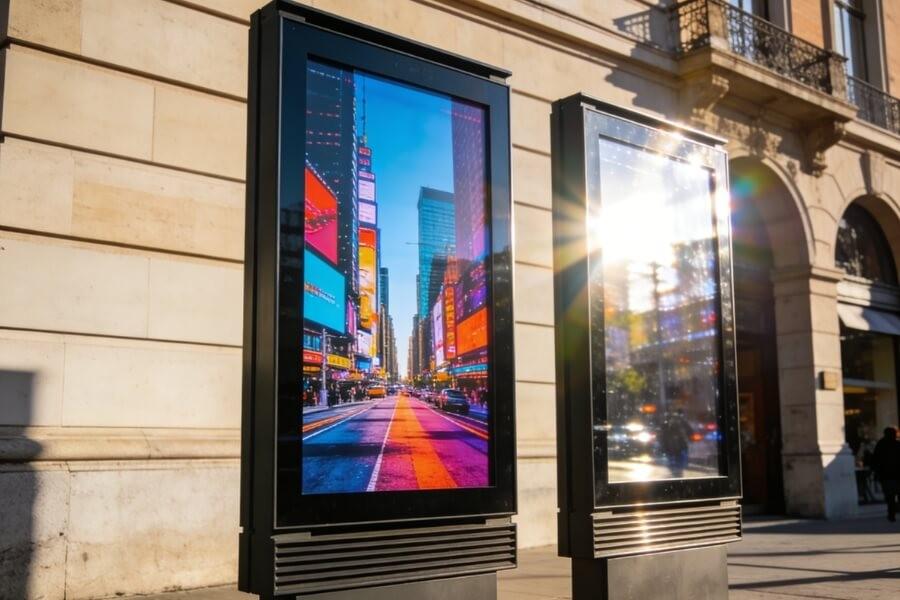
Outdoor high brightness displays are built for advertising and information delivery in outdoor environments, including streets, transportation areas, drive-through lanes, and public spaces.
In addition to adequate brightness, outdoor installations may require:
- Weather-resistant enclosure design
- Effective thermal management
- Protection against dust and water ingress
- UV-resistant materials where appropriate
- Reliable continuous-operation performance
- Remote content management
- Suitable operating-temperature specifications
For outdoor projects, buyers should evaluate the complete system rather than focusing on brightness alone. An outdoor display must manage heat, moisture, dust, and changing environmental conditions while maintaining readable content.
High Brightness Display vs. Standard Display
The main difference between a high brightness display and a standard display is its ability to maintain visibility under stronger ambient lighting.
| Feature | Standard Display | High Brightness Display |
|---|---|---|
| Brightness | Typically lower | Higher, depending on configuration |
| Bright indoor environments | May have limited visibility | Better visibility when properly specified |
| Shop-window advertising | May be difficult to see in daylight | Designed for brighter viewing conditions |
| Outdoor applications | Usually unsuitable without specific protection and design | Available in models engineered for outdoor use |
| Thermal requirements | Generally lower at comparable configurations | May require enhanced cooling |
| Typical applications | Offices, homes, controlled lighting | Retail, commercial signage, window displays and outdoor advertising |
A high brightness display is not automatically an outdoor display. Outdoor suitability also depends on enclosure protection, cooling, materials, operating temperature, and other environmental requirements.
Key Benefits of High Brightness LCD Displays
1. Improved Visibility in Bright Environments
Higher luminance helps digital content remain more visible under strong ambient lighting. This is especially important for shop windows, bright retail interiors, and outdoor advertising locations.
2. More Effective Digital Advertising
Readable content can help businesses communicate promotions, product information, menu options, and brand messages more effectively. For retailers and advertisers, this makes high brightness digital signage a useful tool for capturing attention.
3. Flexible Commercial Applications
High brightness LCD displays are available in different sizes, orientations, enclosure designs, and mounting configurations. This flexibility allows system integrators, distributors, and OEM customers to select products for specific commercial projects.
4. Support for Long Operating Hours
Commercial display projects may require extended daily operating schedules. Buyers should check the manufacturer’s specified duty cycle, operating conditions, warranty terms, and thermal design rather than assuming that every high brightness display supports 24/7 operation.
5. Integration and Customization Options
For OEM and ODM projects, high brightness displays may be customized to meet specific requirements, such as screen size, brightness, enclosure dimensions, touch functionality, connectivity, operating system, and mounting method.
Available options depend on the manufacturer’s product platform and engineering capabilities.
What Factors Should You Consider When Choosing a High Brightness Display?
For distributors, system integrators, commercial project contractors, and bulk buyers, the following factors can help narrow down suitable products.
1. Brightness and Ambient Light
Estimate the lighting conditions at the installation site. A screen facing direct sunlight may require a different specification from one installed inside a bright shopping mall.
Ask the supplier to clarify whether the quoted brightness is a typical or guaranteed value and whether it is measured at the LCD panel or at the complete display output.
2. Screen Size and Resolution
Choose screen dimensions and resolution according to viewing distance, content type, and installation space. Text-heavy menus and detailed advertising content may require different specifications from large-format promotional visuals.
3. Optical Performance
Brightness is only one part of image visibility. Contrast ratio, viewing angle, anti-glare treatment, reflections, and ambient-light conditions also influence readability.
4. Thermal Management
Higher brightness can increase power consumption and heat generation. Effective thermal management is particularly important for enclosed displays, slim designs, and outdoor products operating in warm climates.
5. Indoor, Semi-Outdoor, or Outdoor Design
Confirm the intended installation environment. A window-facing indoor display is not necessarily suitable for rain exposure or outdoor temperature extremes.
For outdoor applications, request the relevant IP rating, operating-temperature range, cooling specifications, and enclosure details.
6. Connectivity and Content Management
Depending on the project, buyers may need HDMI, USB, Wi-Fi, Ethernet, Android or Windows platforms, remote content management, or integration with an existing digital signage CMS.
Confirm compatibility before placing a bulk order.
7. OEM/ODM Customization and Supply Capacity
For large projects or long-term distribution, evaluate whether the manufacturer can support product customization, engineering communication, sample validation, quality control, production planning, and after-sales service.
Request information about minimum order quantities, sample lead times, production lead times, packaging, warranty, and spare-parts support.
Common Applications of High Brightness Digital Signage
High brightness digital signage is used across many commercial sectors.
- Retail and shopping malls: Storefront promotions, brand campaigns, and product advertising.
- Restaurants and QSR chains: Digital menu boards, promotional screens, and drive-through menu displays.
- Transportation: Passenger information, advertising, and wayfinding displays.
- Outdoor advertising: Street-side promotions, public information, and commercial campaigns.
- Corporate and exhibition spaces: Visitor information, brand presentations, and product demonstrations.
- System integration projects: Custom display solutions for kiosks, cabinets, and specialized commercial equipment.
The best product configuration depends on the site’s lighting, environmental conditions, installation method, and content requirements.
Why Source High Brightness Displays from a Manufacturer?
For B2B buyers, working directly with a display manufacturer can make product customization and project communication more efficient.
Potential benefits include:
- OEM/ODM development: Adapt product specifications to project requirements.
- Product selection support: Match brightness, size, mounting, and environmental protection to the application.
- Engineering communication: Discuss interfaces, mechanical dimensions, cooling, and integration needs.
- Bulk-order coordination: Align production schedules, quality requirements, packaging, and shipment planning.
- Long-term product consistency: Establish specifications and quality expectations for repeat orders.
When evaluating suppliers, ask for detailed datasheets, sample units, quality-control procedures, relevant compliance documentation, warranty conditions, and project references where available.
Kontech is a commercial display manufacturer offering high brightness display solutions for B2B applications. Buyers can explore its product range for indoor digital signage, high brightness window displays, outdoor digital signage, and other commercial LCD display applications.
Frequently Asked Questions About High Brightness Displays
What is considered a high brightness display?
A high brightness display generally offers greater luminance than a standard display. Commercial products may range from approximately 500 nits to more than 2,500 nits, depending on their intended application. There is no universal brightness threshold for every use case.
How many nits do I need for a sunlight-readable display?
The required brightness depends on direct sunlight exposure, screen orientation, reflections, and optical design. Some applications may work well at around 1,000 nits, while more demanding environments may require 1,500–2,500 nits or more. Test the display under representative lighting conditions whenever possible.
Is a high brightness display suitable for outdoor use?
Not necessarily. Outdoor use also requires appropriate weather protection, thermal management, materials, and operating-temperature specifications. Confirm that the complete product is designed for the intended outdoor environment.
Does higher brightness mean better image quality?
Not always. Higher brightness can improve visibility in bright environments, but image quality also depends on contrast, color performance, viewing angle, reflections, and content quality. Excessive brightness in a dim environment may cause discomfort and unnecessary power consumption.
Can high brightness displays operate 24/7?
Some commercial displays are designed for continuous operation, but this capability varies by model. Check the manufacturer’s rated duty cycle, thermal design, warranty terms, and maintenance requirements.
Can I order customized high brightness displays from a manufacturer?
Many manufacturers offer OEM/ODM options, depending on their capabilities. Customization may include screen size, brightness, enclosure design, mounting, connectivity, and software configuration. Confirm technical feasibility, MOQ, lead time, and validation requirements with the supplier.
What is the difference between a high brightness display and a sunlight-readable display?
The terms are related but not identical. High brightness describes a display’s luminance capability, while sunlight-readable describes its ability to remain legible in strong sunlight. Sunlight readability also depends on reflections, contrast, optical bonding, screen orientation, and ambient-light conditions.
Find the Right High Brightness Display for Your Project
Looking for a reliable high brightness display supplier for distribution, system integration, OEM/ODM development, or commercial display projects?
Kontech provides commercial display solutions for different installation environments and project requirements.
Contact Kontech to discuss your project specifications, customization options, sample requirements, and bulk-order needs.
Explore our product categories:
- Indoor Digital Signage
- High Brightness Window Displays
- Outdoor Digital Signage
- Commercial LCD Monitors
Contact our team to find a suitable display solution for your next project.
