Outdoor Digital Signage Buying Guide: The Definitive B2B Hardware Selection Manual
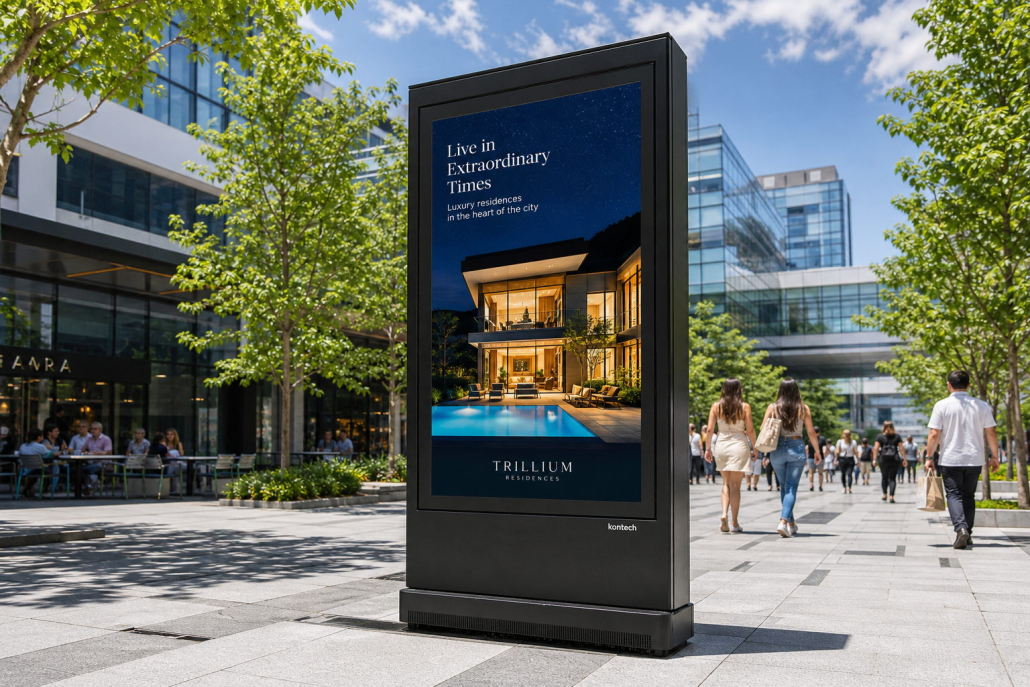
Deploying digital signage outdoors is one of the most powerful methods to capture high-volume pedestrian footfall, drive drive-thru quick-service restaurant (QSR) sales, and modernize municipal transit infrastructure. However, outdoor commercial environments are brutal.
Unlike temperature-controlled indoor retail stores, an outdoor digital display must withstand torrential rainstorms, freezing winter blizzards (-20°C), scorching summer heatwaves (50°C), blinding direct solar radiation, ambient airborne dust, and the threat of physical vandalism in public spaces.
Attempting to cut corners by placing semi-commercial or indoor screens in shaded outdoor locations inevitably results in catastrophic hardware failure—blackened screens from thermal solar clearing, corroded motherboards, shattered glass, and washed-out illegible content.
This comprehensive B2B buying guide provides enterprise buyers, AV integrators, and project engineers with the essential technical criteria for selecting rugged, high-ROI commercial outdoor displays, anchored in Kontech’s ODF Series industrial-grade engineering specifications.
1. Sunlight Readability: Luminance (Nits) & Optical Anti-Glare Engineering
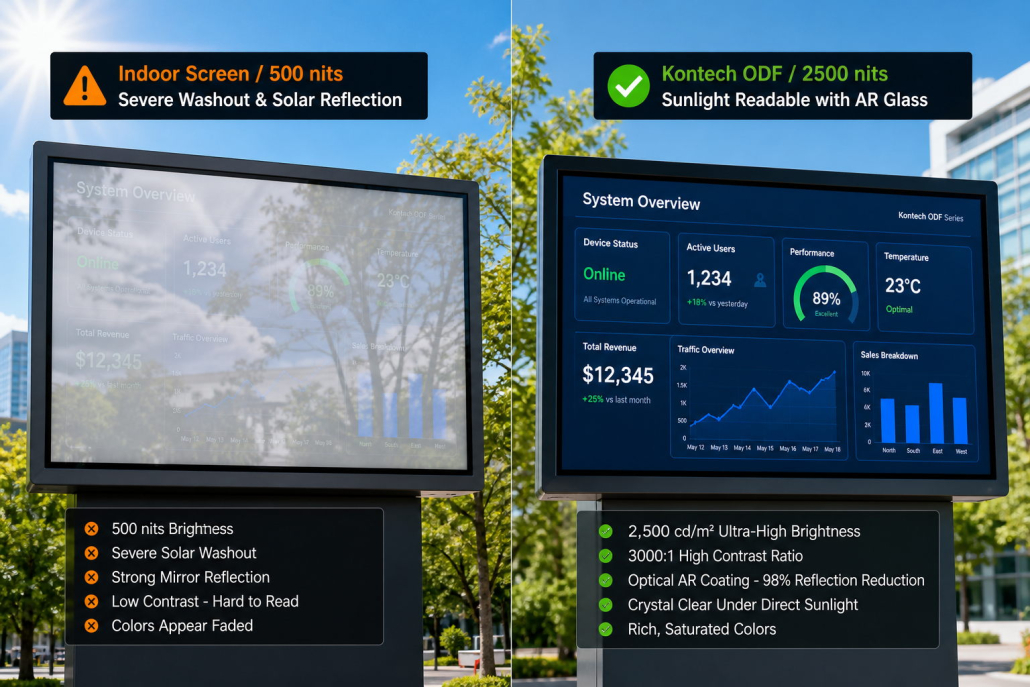
The single most common mistake in outdoor digital signage procurement is underestimating the power of ambient sunlight. While standard indoor commercial displays output between 350 to 700 nits, direct sunlight delivers ambient luminance exceeding 10,000 lux. A 500-nit screen exposed to direct sunlight will appear completely washed out, turning into an illegible dark gray mirror.
Outdoor Luminance Selection Matrix:
┌────────────────────────────────────────────────────────────────────────┐
│ AMBIENT LIGHT CONDITION   │ RECOMMENDED BRIGHTNESS │ APPLICATION       │
├───────────────────────────┼────────────────────────┼───────────────────┤
│ Shaded / Under Canopy     │ 1,500 – 2,000 nits     │ Train platforms,  │
│ (No Direct Sunlight)      │                        │ covered walk-ups  │
├───────────────────────────┼────────────────────────┼───────────────────┤
│ Full Direct Sunlight      │ 2,500 – 3,500 nits     │ Street totems,    │
│ (Open Plazas, Drive-Thrus)│ (Kontech ODF Standard) │ outdoor kiosks    │
└────────────────────────────────────────────────────────────────────────┘
Crucial Optical Technologies:
- 2,500 to 3,500 Nits Ultra-High Brightness: Kontech ODF series outdoor displays feature industrial-grade LED backlights outputting 2,000 cd/m² (32″) to 2,500 cd/m² (43″–75″), with optional configurations reaching 3,500 nits. This ensures saturated, crystal-clear 4K visual punch even under midday desert sun.
- 5mm AR (Anti-Reflective) & AG (Anti-Glare) Safety Glass: Raw glass reflects approximately 4% to 8% of ambient light, obscuring content. Kontech equips its outdoor screens with optical-grade Anti-Reflective glass that cuts surface reflections by up to 98%, maintaining rich contrast (up to 3000:1) and eliminating distracting mirror reflections.
- Circular Polarization (QWP Sunglasses Compatibility): Standard LCD panels emit linearly polarized light. Customers wearing polarized sunglasses will see a completely blacked-out screen at certain viewing angles. Kontech outdoor displays incorporate Quarter-Wave Plate (QWP) circular polarization technology, guaranteeing 100% visual clarity from all 178° viewing angles, regardless of polarized eyewear.
- Intelligent Ambient Light Auto-Dimming: Operating at 2,500 nits at midnight causes severe light pollution and wastes electricity. Integrated ambient optical sensors automatically scale backlight output down to 300–500 nits after dusk, slashing energy costs by 30% to 40% and extending the LED backlight lifespan beyond 50,000 hours.
2. Environmental Ingress Protection: IP55 vs. IP65 vs. IP66
Ingress Protection (IP) ratings define how effectively an electrical enclosure keeps out solid particulates (dust, dirt) and liquids (rain, splashing water, high-pressure jets).
IP Rating Breakdown for Outdoor Signage:
  IP [ 6 ] [ 5 ]
       │     └── LIQUID PROTECTION: 5 = Water jets from any direction
└──────── DUST PROTECTION: 6 = Completely dust-tight (airtight)- IP55 (Weather-Resistant): Protected against dust ingress (limited ingress, no harmful deposits) and low-pressure water jets. Suitable for semi-outdoor covered walkways, stadium concourses, and covered transit canopies.
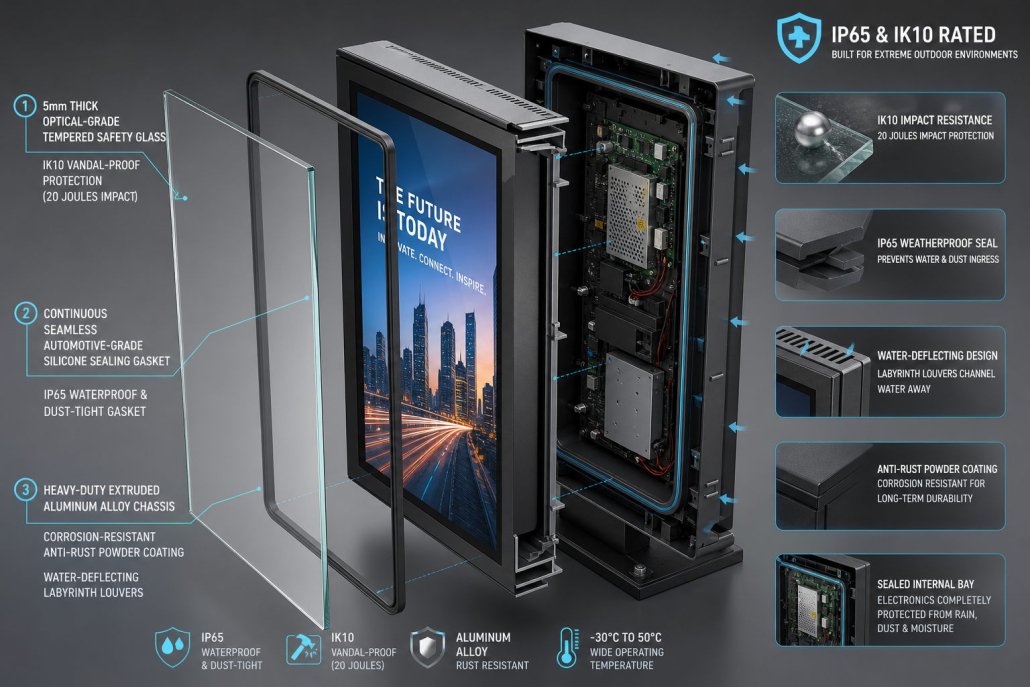
- IP65 (Full Weatherproof & Washdown Rated): Completely dust-tight. Protected against water projected by a 6.3mm nozzle from any direction. This is the gold standard for freestanding outdoor totems, street displays, and drive-thru menu boards. It withstands torrential rain, snow, blowing sand, and routine cleaning hose-downs.
- IP66 (Extreme Weather & Marine): Protected against heavy seas and powerful water jets (12.5mm nozzle at 100 kPa). Essential for coastal marine piers, car washes, and hurricane-prone zones.
Kontech Cabinet Engineering:
Kontech ODF series enclosures utilize heavy-duty corrosion-resistant aluminum alloy cabinets finished with industrial outdoor powder coating. All seams, cable entry ports, and door perimeters are sealed with closed-cell automotive-grade silicone gaskets, completely isolating internal electronics from moisture, humidity (10%–100%), and corrosive salt fog.
3. Thermal Management: Operating from -20°C to 50°C
Outdoor screens face extreme thermal loads from two simultaneous sources: internal heat generated by 2,500-nit high-power LED backlights (drawing 250W to 840W) and external radiant solar heat.
The Danger of “Solar Clearing” (Black Spots):
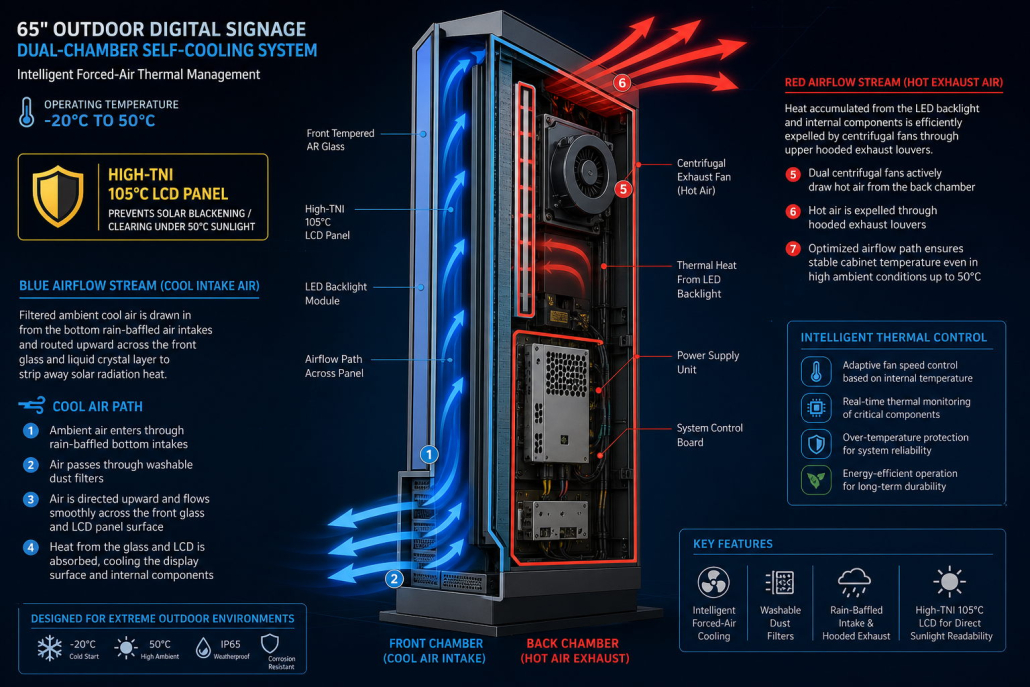
When standard LCD panels exceed internal temperatures of 75°C to 85°C, the liquid crystals lose their twisted nematic alignment, turning completely black in patches (solar blackening). Kontech outdoor displays utilize High-TNI (105°C / 110°C) specialized commercial liquid crystal panels that remain optically stable and prevent solar clearing even when exposed to intense summer solar irradiation.
Thermal Cooling Architectures:
- Intelligent Forced-Air Self-Cooling (Kontech Standard): A dual-chamber internal airflow design with thermostat-controlled centrifugal fans. Air is filtered and circulated across the rear of the LCD glass and power supply, expelling heat through rain-baffled exhaust louvers. This enables reliable 24/7 operation from -20°C to 50°C without requiring expensive, power-hungry air conditioning units.
- Closed-Loop HVAC Air Conditioning (Optional for Extreme Climates): For desert environments consistently exceeding 50°C (122°F), an integrated compressor air conditioner maintains a hermetically sealed internal chamber at an optimal 20°C–25°C.
4. Physical Security & Vandalism Resistance: IK10 Certification
Publicly accessible outdoor displays in plazas, bus stops, and storefronts are vulnerable to accidental impacts, vandalism, and attempted forced entry.
- IK10 Impact Rating: Kontech outdoor digital signage is shielded by 5mm high-strength tempered safety glass rated to IK10 standards. This certifies the display to withstand an impact energy of 20 Joules (equivalent to a 5.0 kg steel mass dropped from a height of 400 mm directly onto the screen face) without shattering.
- Anti-Theft Enclosure Hardware: Cabinets feature concealed, heavy-duty interior hinges, anti-pry flush seams, and multi-point mechanical cylinder cam locks to prevent unauthorized tampering with internal media players and cabling.
5. Media Players, Connectivity & CMS Operating Systems
An outdoor display is only as reliable as its internal computing hardware:
- Integrated SoC vs. Modular OPS Slot: Kontech ODF displays come standard with an embedded industrial Android 9.0 SoC (Quad-Core Cortex-A35, Mali-G31 GPU, 2GB RAM, 16GB ROM) supporting all major digital signage CMS apps. Optional configurations support Windows 10/11 IoT or Linux via internal industrial box PCs.
- Industrial Connectivity Ports: Dual HDMI inputs, USB 2.0/3.0, Gigabit RJ45 Ethernet, and RS-232 serial control for remote power cycling.
- Failover Local Storage: In the event of a cellular or broadband internet outage, the onboard local flash memory continues smooth offline playback of video and graphics schedules, eliminating dreaded blue screens or blank displays.
6. Hardware Specifications Matrix: Kontech ODF Series
Operating Environment: -20°C to 50°C | Ingress Rating: IP55 / IP65 | Impact: IK10 5mm AG/AR Glass | Warranty: 3-Year Onsite/Factory Warranty
7. Frequently Asked Questions (FAQ)
Q1: Can I install an indoor commercial screen inside an outdoor third-party waterproof enclosure?
A: While third-party boxes provide water protection, they almost always fail to solve solar clearing and optical reflection. Standard indoor screens lack 2,500-nit luminance (causing severe washout) and have low-TNI panels that turn black under direct sun. An integrated outdoor commercial display like the Kontech ODF series provides engineered thermal balancing and anti-reflective optics in a purpose-built aluminum cabinet.
Q2: What is the difference between Wall-Mount and Floor-Standing outdoor displays?
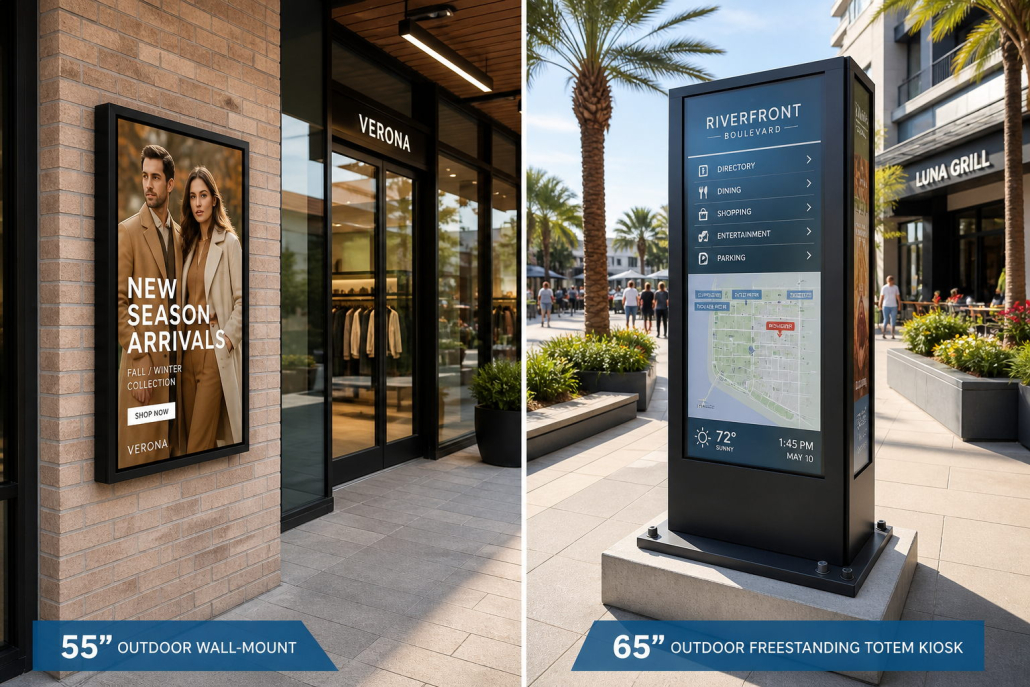
A: Wall-mounted outdoor displays are fixed to structural facades or pillars using heavy-duty VESA brackets, ideal for store entrances and transit platforms. Floor-standing totems (kiosks) feature an integrated reinforced pedestal base anchored into a concrete footing with galvanized wedge bolts, perfect for pedestrian plazas and drive-thru lanes.
Q3: How much electricity does an outdoor digital display consume?
A: Depending on screen size, peak consumption ranges from 210W (32″) to 480W (65″) at maximum 2,500-nit brightness. However, because ambient light auto-dimming reduces brightness by up to 80% during evening and overcast hours, real-world 24-hour average power consumption is typically 30% to 40% lower than maximum rated wattage.

