
Future Trends of Digital Menu Boards in the Food Service Industry
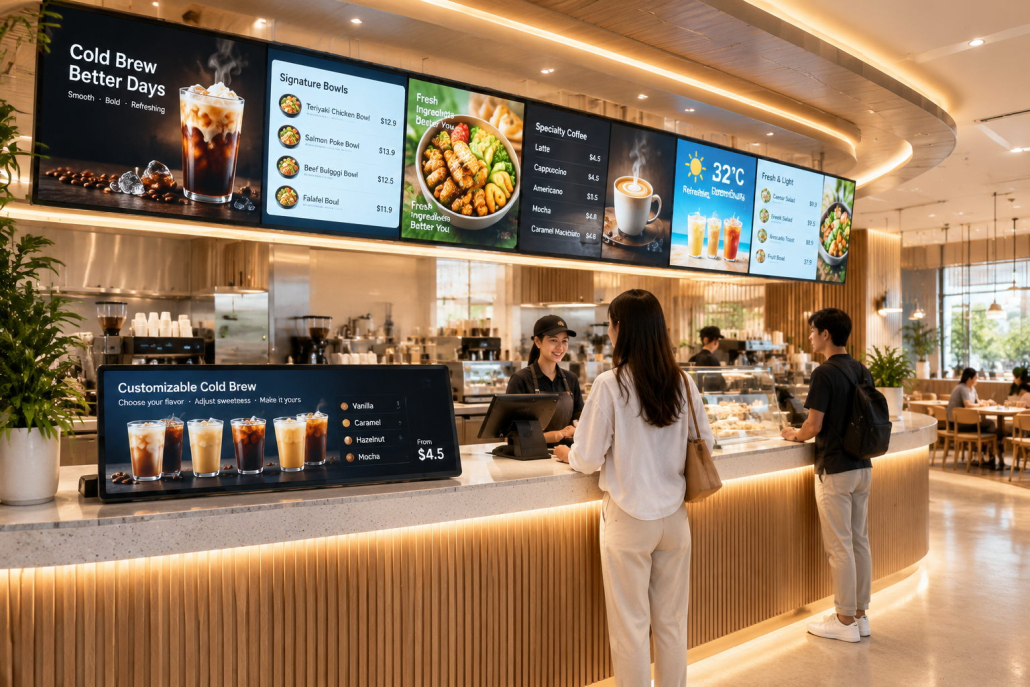 The food service industry is becoming increasingly digital. From quick-service restaurants (QSRs) and fast-food chains to cafés, bakeries, food courts, and drive-thru restaurants, businesses are adopting digital technologies to improve customer experiences, streamline operations, and strengthen brand consistency.
Digital menu boards are an important part of this transformation. Unlike traditional printed menus, digital menu boards allow restaurants to update prices, showcase new products, promote limited-time offers, and manage content across multiple locations more efficiently.
As display technology, artificial intelligence (AI), cloud software, and restaurant automation continue to develop, digital menu boards are expected to become more intelligent, connected, and flexible.
In this article, we explore the key future trends of digital menu boards in the food service industry and explain what restaurant operators, distributors, and commercial display buyers should consider when planning their next project.
1. AI-Powered Menu Optimization
Artificial intelligence is becoming an important technology in restaurant operations, including menu planning, customer service, and marketing.
In the future, AI-powered systems may help restaurants analyze sales data, identify popular products, and recommend menu content based on time of day, location, inventory, or business objectives.
For example, a restaurant might highlight breakfast items in the morning, promote lunch combinations around midday, and feature desserts or beverages later in the day. These changes can be scheduled automatically or recommended by software, depending on the system’s capabilities.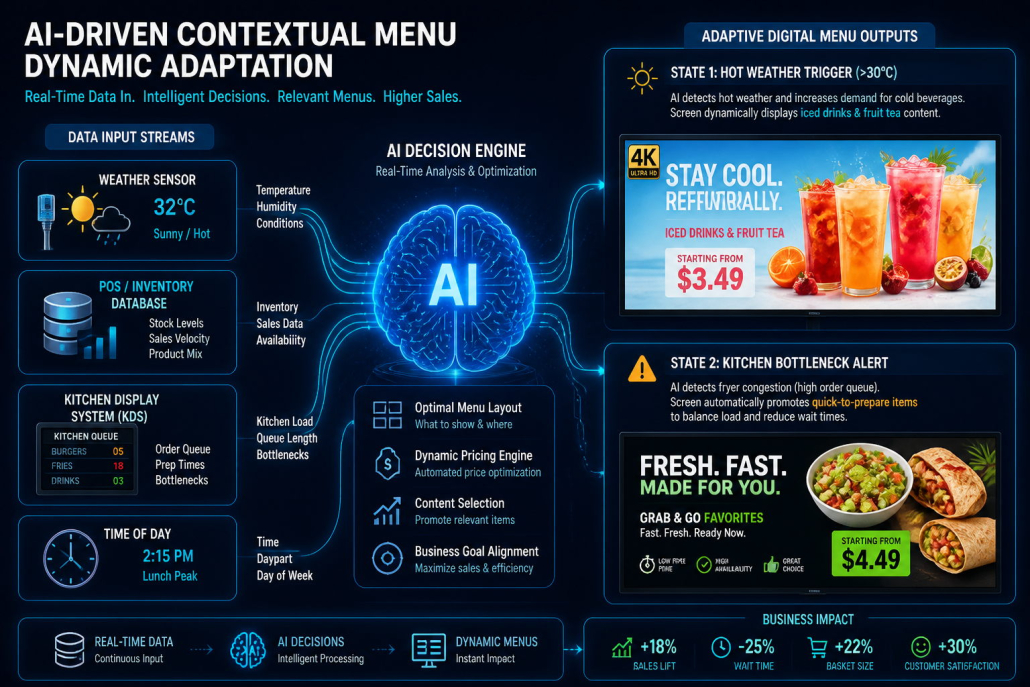
Potential benefits include:
- More relevant menu promotions
- Faster content planning
- Better use of sales and inventory data
- More efficient campaign management across locations
- Improved coordination between menu content and business goals
AI does not replace the need for good menu design or accurate pricing. Restaurants should retain control over pricing, allergen information, product availability, and promotional approvals.
For digital menu board buyers, compatibility with third-party software and reliable display performance will remain important considerations.
2. Cloud-Based Content Management for Restaurant Chains
Cloud-based content management systems (CMS) are expected to remain a major trend as restaurant brands expand across regions and countries.
Instead of updating each screen manually, restaurant teams can use centralized software to publish menus, schedule campaigns, and manage content across multiple locations.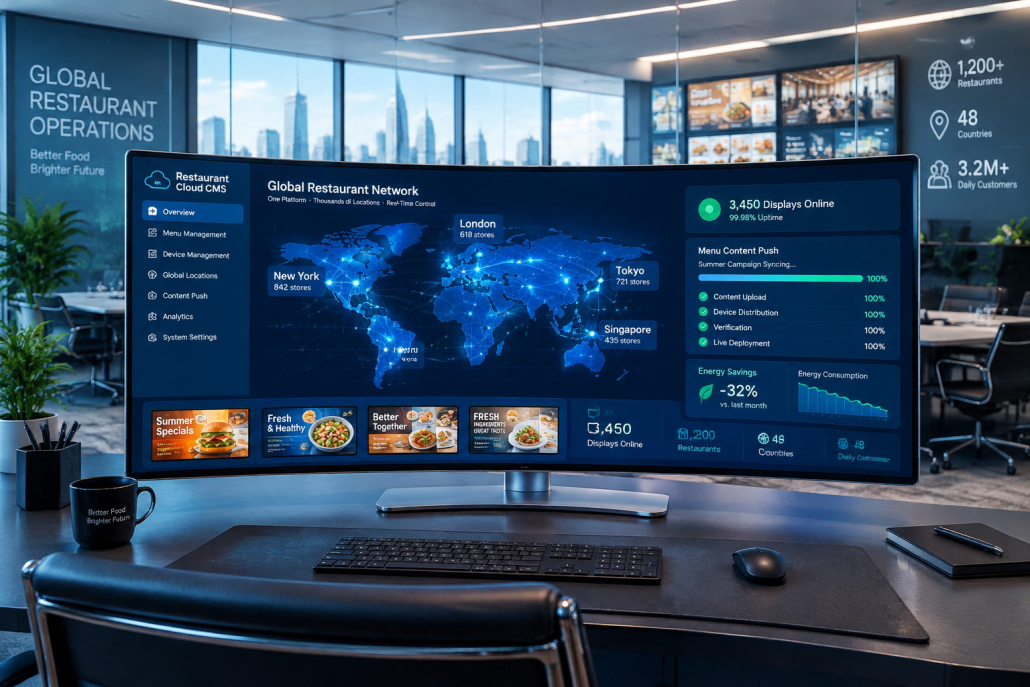
A cloud-based digital signage system may support:
- Centralized menu updates
- Scheduled promotions
- Location-specific content
- User permissions and approval workflows
- Remote device monitoring, where supported
- Content consistency across multiple stores
For a restaurant chain with dozens or hundreds of locations, centralized management can reduce repetitive work and help maintain consistent brand presentation.
However, the display hardware, operating system, media player, network connection, and CMS must work together. Buyers should confirm software compatibility, security requirements, offline playback behavior, and ongoing subscription costs before deploying a large-scale system.
3. More Personalized and Context-Aware Menus
Personalization is another developing trend in digital menu boards.
Restaurants may increasingly use contextual information—such as time of day, local promotions, store location, weather, or inventory—to decide which products to highlight.
For example, a café might promote iced drinks during warmer weather, while a restaurant in a tourist area could display localized offers or language options.
More advanced systems may combine digital signage with loyalty programs, mobile ordering, or customer relationship management platforms. The extent of personalization depends on the software, data available, and the restaurant’s implementation.
Restaurants should also consider privacy, customer consent, data protection, and applicable local regulations when using customer-related information.
The practical objective is not simply to display more content. It is to present relevant information in a clear, timely, and useful way.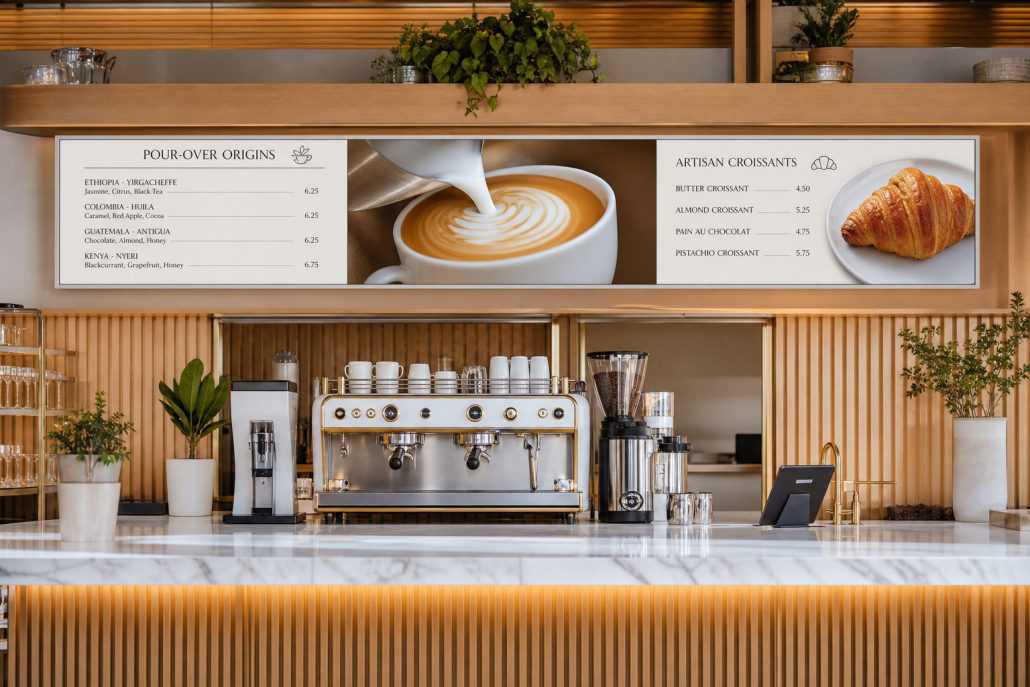
4. Dynamic Pricing and Real-Time Menu Updates
Traditional printed menus can be expensive and time-consuming to update when prices, ingredients, or promotions change. Digital menu boards make it easier to publish updates without replacing physical signage.
In the future, more restaurants may connect menu systems with point-of-sale (POS), inventory, and ordering platforms to improve operational consistency.
Potential applications include:
- Updating prices across approved locations
- Scheduling time-limited promotions
- Marking products as unavailable
- Adjusting menus for breakfast, lunch, and dinner
- Synchronizing displayed information with ordering systems
Some of these functions are already available in certain restaurant software platforms, but they are not automatically included with every digital display.
A reliable implementation requires integration between the menu software, POS or ordering platform, and content management system. Restaurants should establish approval rules and verification procedures to prevent pricing errors or outdated information.
5. Interactive Ordering and Self-Service Integration
Digital menu boards are increasingly being deployed alongside self-order kiosks, mobile ordering, and other digital customer interfaces.
Although a standard menu board primarily presents information, interactive displays and touch-enabled ordering systems can allow customers to explore menu categories, customize products, and place orders directly.
Possible applications include:
- Touchscreen ordering stations
- Interactive product information
- Menu displays connected to self-service kiosks
- Mobile ordering integration
- Order status and pickup information screens
Not every restaurant needs an interactive screen. For busy quick-service restaurants, a clearly organized menu board combined with a separate self-order kiosk may offer a better customer experience than adding touch functionality to every display.
When planning a project, buyers should distinguish between passive digital menu boards, interactive touch displays, and dedicated self-service ordering terminals. Each has different hardware, software, hygiene, and maintenance requirements.
6. High-Brightness Outdoor Digital Menu Boards
Outdoor ordering and drive-thru services continue to create demand for displays that remain readable under challenging lighting and weather conditions.
As restaurant operators invest in drive-thru experiences and exterior advertising, high-brightness digital menu boards will remain an important product category.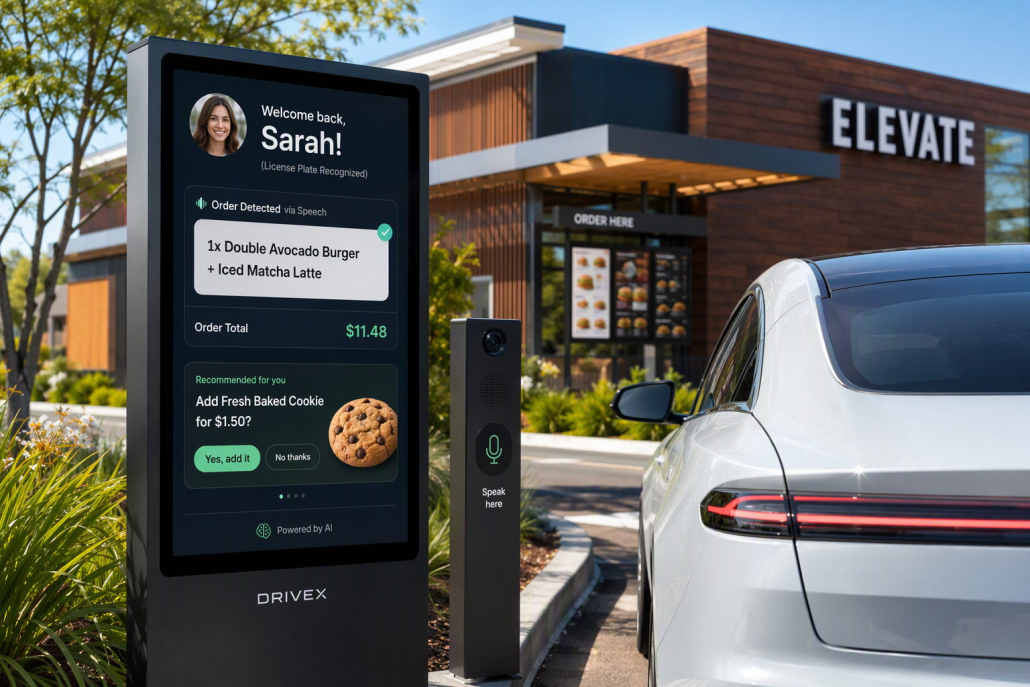
Key requirements may include:
- High brightness for daylight visibility
- Anti-glare design appropriate to the application
- Weather-resistant enclosure
- Protection against dust and water ingress
- Thermal management for hot and cold environments
- Remote content updates and scheduled operation
- Mounting options suitable for the site
The required brightness depends on direct sunlight, screen orientation, reflections, viewing distance, and local conditions. A higher brightness rating alone does not guarantee visibility if the screen has severe reflections or is positioned incorrectly.
Outdoor equipment must be selected according to its specified environmental ratings and operating temperature range. Standard indoor commercial displays should not be assumed to be suitable for outdoor use.
For manufacturers and distributors, offering different brightness levels, enclosure designs, and mounting configurations can help serve a wider range of restaurant projects.
7. Energy Efficiency and More Reliable Display Design
Energy efficiency and long-term reliability are becoming increasingly important in commercial display procurement.
Restaurants may operate menu screens for extended hours, sometimes across multiple shifts and locations. Display power consumption, heat dissipation, maintenance access, and product service life can therefore affect the total cost of ownership.
Future purchasing decisions are likely to place continued emphasis on:
- Efficient LED backlighting
- Suitable brightness control
- Effective thermal management
- Stable performance during extended operation
- Easy access for cleaning and maintenance
- Availability of replacement parts
- Consistent specifications across deployments
Features such as automatic brightness adjustment, scheduled power management, and remote device monitoring may be available depending on the display and software platform.
Buyers should compare actual power consumption, operating conditions, warranty coverage, and maintenance requirements rather than evaluating equipment solely by its initial purchase price.
8. Multi-Screen Menu Boards and Consistent Brand Experiences
Many quick-service restaurants use multiple screens to organize menus into clear categories, such as main dishes, meal combinations, drinks, and desserts.
As menu content grows and campaigns become more sophisticated, multi-screen layouts can help restaurants present information in a more organized way.
Future systems may make it easier to coordinate content across multiple displays, synchronize promotions, and apply brand templates across different store formats.
When designing a multi-screen installation, restaurants should consider:
- Overall screen layout and viewing distance
- Consistent brightness and color appearance
- Bezel spacing and alignment
- Content distribution across screens
- Software support for multi-screen playback
- Maintenance access and cable management
For restaurant chains, standardized display specifications and installation guidelines can simplify procurement and reduce differences between locations.
9. Integration with Restaurant Operations and Data Systems
Digital menu boards are becoming part of a broader restaurant technology ecosystem rather than operating as isolated screens.
Depending on the solution, future integrations may connect digital signage with POS platforms, kitchen display systems, inventory tools, loyalty programs, mobile apps, and business analytics.
These integrations can help restaurants align displayed menus with current operations and reduce the manual work involved in managing content.
However, integration complexity should not be underestimated. Different systems may use different APIs, data formats, access controls, and update schedules.
Before purchasing hardware for a large project, restaurant operators and system integrators should confirm:
- Compatibility with existing software
- Integration responsibilities and technical support
- Network and cybersecurity requirements
- Data synchronization and error handling
- Offline behavior during network interruptions
- Long-term software and licensing costs
A well-planned system should be reliable and manageable, not simply connected to as many platforms as possible.
10. What Restaurant Buyers Should Look for in Digital Menu Board Displays
As digital menu board projects become more sophisticated, choosing the right display hardware remains essential.
Restaurant operators, distributors, and system integrators should evaluate the following factors.
Display Specifications
Confirm screen size, resolution, brightness, viewing angle, portrait or landscape orientation, and the intended viewing distance.
Installation Environment
Determine whether the display will be installed indoors, near a window, in a semi-outdoor area, or outdoors. Environmental protection and temperature requirements should match the actual site.
Operating Requirements
Check the expected daily operating hours, thermal design, power consumption, and suitability for continuous commercial use.
Software Compatibility
Verify compatibility with the required CMS, media player, operating system, POS integration, and remote management platform.
Mounting and Connectivity
Confirm VESA compatibility where applicable, mounting structure requirements, available signal interfaces, power connections, and cable routing.
Customization and Supply Support
For chain restaurants and distributors, evaluate available screen sizes, brightness options, enclosure designs, OEM/ODM services, product consistency, spare parts, and after-sales support.
A display manufacturer with experience in commercial applications can help buyers assess these factors before finalizing specifications.
11. How Kontech Supports Commercial Digital Menu Board Projects
For restaurant brands, equipment distributors, and system integrators, a suitable manufacturing partner can help translate project requirements into a practical display solution.
Kontech provides commercial display solutions for business applications, including digital signage and high-brightness displays.
When evaluating a restaurant digital menu board project, buyers can define their requirements around:
- Indoor or outdoor installation
- Screen size and brightness
- Wall-mounted, ceiling-suspended, or freestanding configurations
- Operating environment and thermal requirements
- Connectivity and content management compatibility
- OEM/ODM customization needs
- Project quantity and rollout schedule
Discussing these details early can help reduce compatibility risks and improve planning for multi-location installations.
For B2B buyers, the goal is to select displays that meet the real application requirements, support reliable daily operation, and fit the project’s long-term maintenance and expansion plans.

