
Best Digital Signage Solutions for Fashion Retail Stores
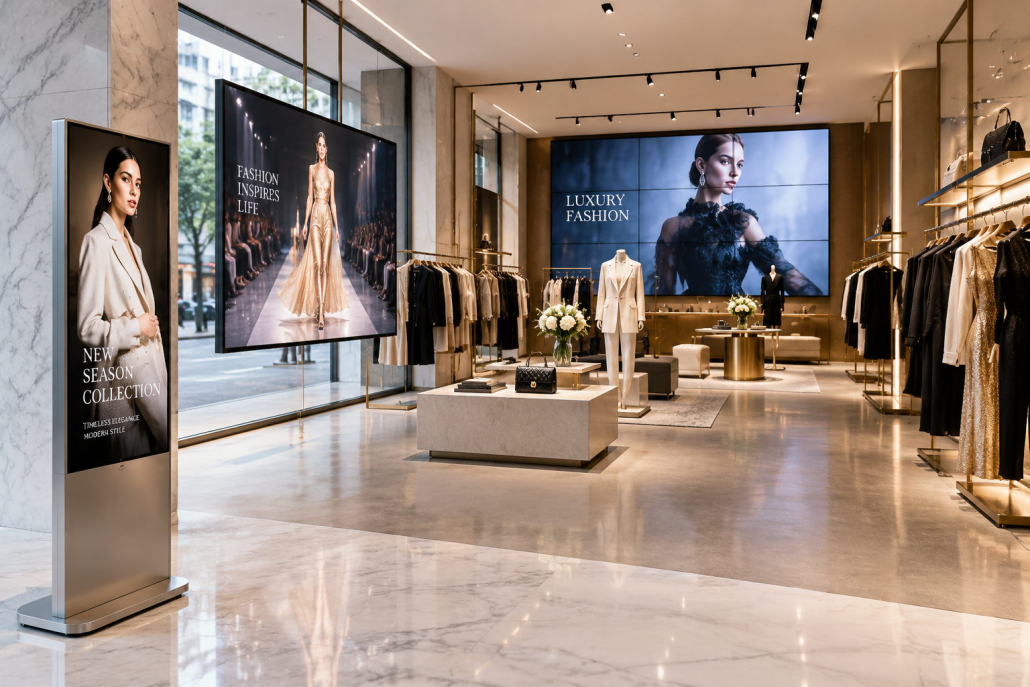 In fashion retail, first impressions matter. Before customers enter a clothing store, they often notice the storefront, seasonal displays, new arrivals, and promotional messages. An attractive retail environment can help communicate a brand’s identity, showcase collections, and encourage shoppers to explore the store.
Digital signage for fashion retail gives brands a flexible way to present product videos, campaign visuals, styling ideas, seasonal promotions, and brand stories. From high-brightness window display screens to indoor advertising displays, the right solution can help fashion retailers create a more engaging shopping experience while keeping marketing content up to date.
But which digital signage solutions are best for fashion stores? Should retailers choose window displays, in-store screens, interactive displays, or a combination of different formats?
This guide explores the best digital signage solutions for fashion retail stores, their key benefits, important technical considerations, and how brands, distributors, and system integrators can select the right commercial displays for their projects.
1. Why Fashion Retail Stores Need Digital Signage
Fashion retail is highly visual. Customers often respond to product presentation, styling inspiration, seasonal trends, and the overall atmosphere of a store. Digital signage helps retailers communicate these elements through dynamic visual content.
Attract Attention from Outside the Store
A storefront is an important advertising space. Digital window displays can present new collections, seasonal campaigns, product videos, and special offers to people passing by.
In busy shopping streets and shopping malls, high-brightness window display screens can help promotional content remain visible in bright environments. The appropriate brightness depends on sunlight exposure, glass reflections, viewing distance, and the store’s layout.
Showcase Collections and Styling Ideas
Fashion retailers can use digital displays to show complete outfits, styling combinations, product details, and campaign photography. This allows customers to see how individual items work together without relying entirely on physical displays.
Promote New Arrivals and Seasonal Campaigns
Digital signage makes it easier to update promotional content for new collections, holiday sales, product launches, and limited-time offers. Retail teams can change campaign visuals without printing and replacing physical posters.
Strengthen Brand Identity
Fashion brands often rely on distinctive visual identities. Carefully selected display sizes, screen placement, video content, and creative layouts can help maintain a consistent brand experience across storefronts and in-store environments.
Support Multi-Store Marketing
For retail chains, centralized digital signage software can help coordinate content across multiple locations when supported by the selected hardware and platform. Marketing teams can distribute approved campaigns while allowing individual stores to use locally relevant content where appropriate.
Digital signage does not guarantee higher sales by itself. Its effectiveness depends on the relevance of the content, placement, store traffic, and the overall customer experience.
2. High-Brightness Window Displays: Turn Storefronts into Advertising Spaces
High-brightness window displays are among the most useful digital signage solutions for fashion retailers that want to attract attention from outside the store.
Unlike ordinary indoor monitors, window-facing displays may need to remain readable under strong ambient light or direct sunlight passing through storefront glass.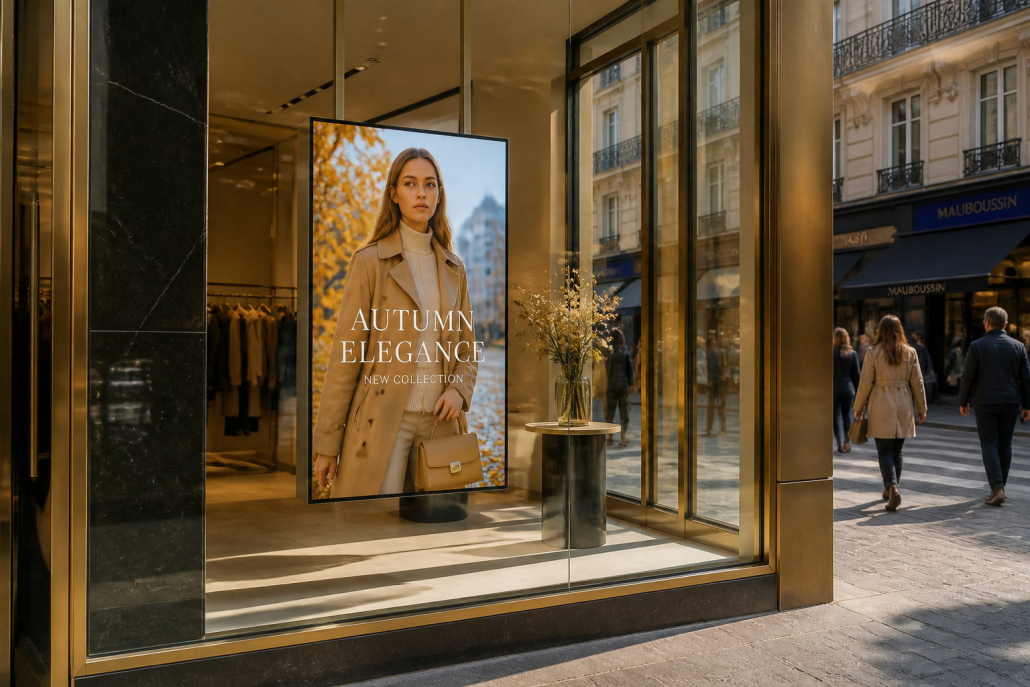
Best Applications
- Fashion boutiques and designer clothing stores
- Shopping mall storefronts
- Sportswear and footwear retailers
- Luxury brand windows
- Department store fashion departments
- Seasonal product and promotional campaigns
Key Features to Consider
High brightness: Choose a brightness level appropriate for the actual window conditions. Brightness requirements can vary considerably depending on window orientation, sunlight exposure, glass transmission, and reflections.
Slim design: A slim enclosure can help the display fit into storefronts where space is limited.
Effective heat management: High-brightness operation generates heat. The display should be suitable for the expected operating hours and installation conditions.
Automatic brightness control: If available, a light sensor can adjust screen brightness as ambient lighting changes.
Flexible mounting: Depending on the store layout, ceiling-suspended, wall-mounted, or floor-standing configurations may be suitable.
Scheduled operation: Scheduling can align screen operation with store opening hours and promotional campaigns.
When evaluating a window display, do not rely on brightness specifications alone. Check visibility in the intended installation environment, viewing angles, glare, and the manufacturer’s recommended operating conditions.
3. In-Store Digital Signage: Enhance the Shopping Experience
Indoor digital signage helps fashion retailers communicate with customers after they enter the store. Screens can complement clothing displays, product fixtures, fitting-room areas, and checkout zones.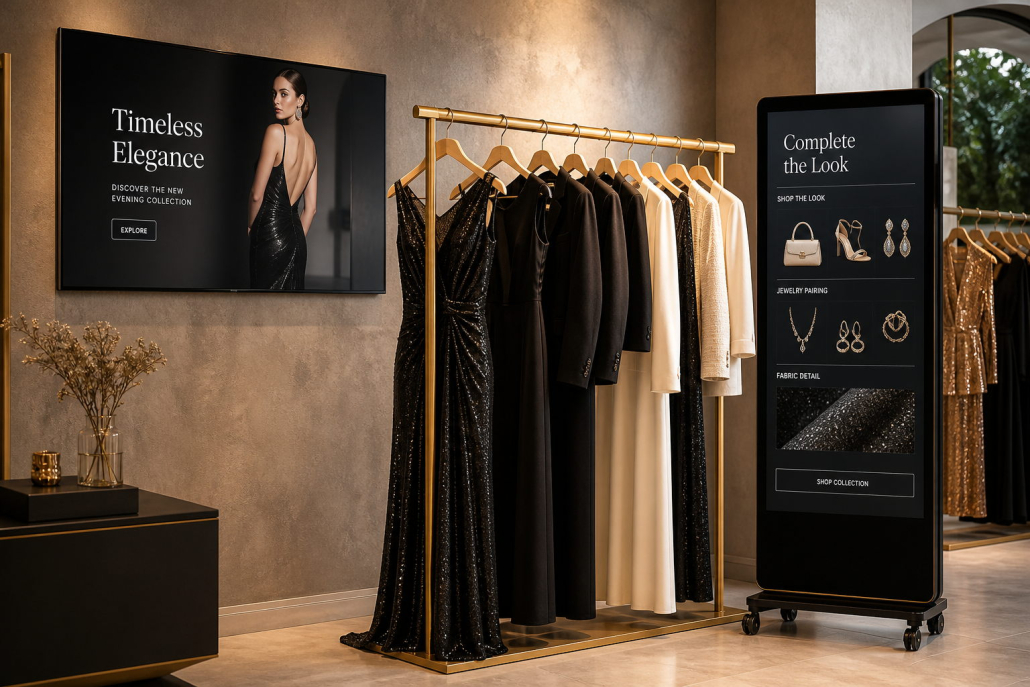
Promotional Screens
Promotional screens can highlight new arrivals, seasonal collections, member benefits, special offers, and brand campaigns.
They work best when the message is concise and the screen is positioned where customers naturally pause or look.
Collection and Brand Storytelling Displays
Fashion brands can use digital screens to present campaign videos, behind-the-scenes footage, designer stories, sustainability information where substantiated, and collection inspiration.
These displays can help create a more consistent brand experience across different stores.
Product Information Displays
Digital displays can show product features, fabric details, styling recommendations, available colors, or related products. The information should be accurate and easy to read from the expected viewing distance.
Checkout and Service-Area Displays
Screens near checkout counters or customer service areas can communicate membership programs, care instructions, upcoming events, and relevant promotions.
The content should remain helpful rather than overwhelming customers with too many competing messages.
4. Digital Signage Solutions for Different Fashion Retail Areas
Different store locations have different viewing conditions and communication objectives. Matching the display to its location helps improve both usability and visual impact.
| Store Area | Recommended Display Solution | Primary Purpose |
|---|---|---|
| Storefront window | High-brightness window display | Attract passersby and showcase campaigns |
| Entrance | Indoor commercial display | Introduce collections and current promotions |
| Main retail floor | Commercial digital signage | Highlight products and brand stories |
| Feature wall | Large-format commercial display | Create a visual focal point |
| Checkout area | Compact commercial screen | Share service information and relevant offers |
| Shopping mall storefront | High-brightness or suspended display | Communicate with mall visitors |
| Multi-store retail network | Network-connected digital signage | Coordinate content across locations |
These are general recommendations. Final selection should account for store size, ambient lighting, viewing distance, installation structure, and the retailer’s content strategy.
5. Single-Sided vs. Double-Sided Window Displays for Fashion Stores
Fashion retailers may choose single-sided or double-sided window displays depending on how the storefront is arranged.
Single-Sided Window Displays
A single-sided display presents content toward one main viewing direction, usually outside the store. It can be a suitable option when the main goal is to attract pedestrians and communicate promotions through the window.
Potential advantages include a straightforward viewing direction and a configuration focused on outward-facing content.
Double-Sided Window Displays
A double-sided display can present content toward both the street and the store interior, depending on its design. It may be useful when both passersby and customers inside the store can benefit from the messaging.
Before selecting a double-sided solution, confirm whether both sides can operate independently, whether their brightness levels differ, and how content is controlled.
Selection tip: Choose the display configuration based on the actual audience and viewing direction, rather than assuming that a double-sided screen is always better.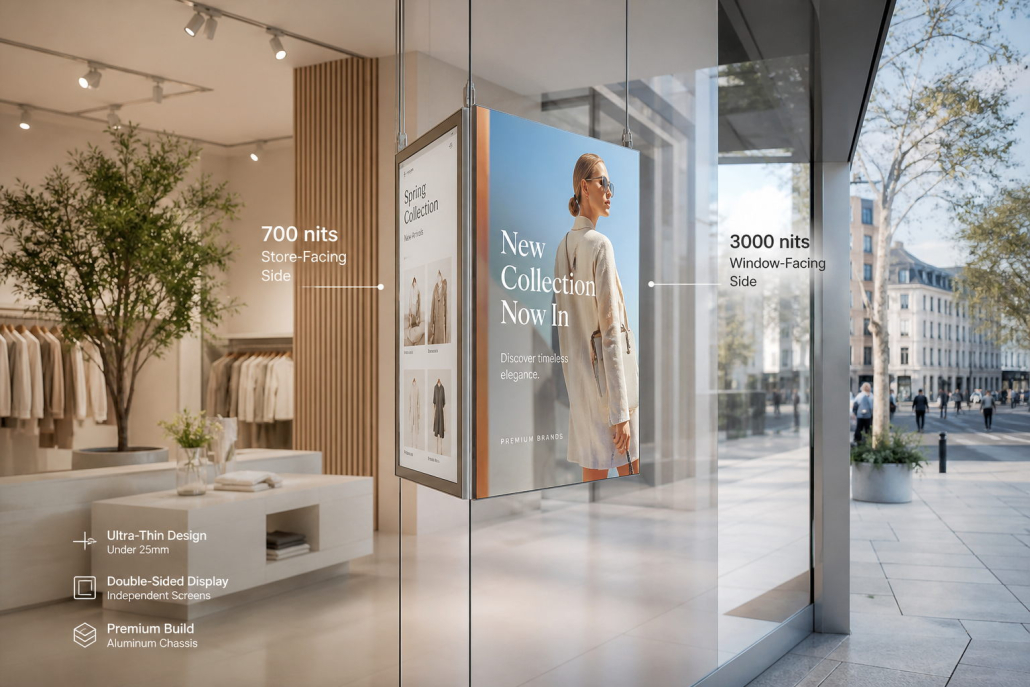
6. How to Choose the Right Screen Size and Brightness
Screen size and brightness are two of the most important technical decisions in a fashion retail digital signage project.
Choosing the Right Screen Size
The ideal screen size depends on:
- Available wall or window space
- Viewing distance
- Content layout and aspect ratio
- Portrait or landscape orientation
- The number of screens in the installation
- The desired visual balance with clothing racks and store fixtures
A large screen may be suitable for a feature wall, while a smaller display may be more appropriate for product information or checkout messaging.
Before ordering, measure the installation area and confirm the display’s overall dimensions, mounting requirements, and service clearance.
Choosing the Right Brightness
Brightness is measured in nits, with one nit equal to one candela per square meter (cd/m²). The required level depends on ambient light and the screen’s position.
| Application | Indicative Brightness Range | Notes |
|---|---|---|
| Indoor areas with controlled lighting | 300–500 nits | May suit many indoor viewing environments |
| General retail advertising | 500–700 nits | Consider surrounding light and viewing distance |
| Bright indoor areas and some window installations | 700–1,500+ nits | Assess glass reflections and daylight conditions |
| Strongly sunlit window-facing applications | 1,500–3,000+ nits | Validate visibility and thermal performance in the actual environment |
These ranges are starting points, not fixed standards. Window orientation, glass properties, direct sunlight, contrast, and reflections can significantly change the required specification.
For window-facing displays, request a model-specific specification sheet and, when practical, test the screen at the intended installation site.
7. Content Strategies That Work for Fashion Retail Digital Signage
The effectiveness of digital signage depends not only on the display hardware but also on the content shown on the screen.
Use High-Quality Fashion Visuals
Fashion relies on imagery. Use clear product photography, campaign videos, styling combinations, and brand-approved creative assets that reflect the intended brand identity.
Keep Messages Simple
People often view storefront displays while walking. Use a clear headline, a strong visual, and one main call to action instead of filling the screen with too much text.
Adapt Content to the Retail Calendar
Plan content around seasonal collections, holidays, new product launches, sales periods, and local events. Update promotions promptly when offers change or expire.
Match Content to Screen Orientation
Portrait screens may suit full-length outfit imagery, while landscape screens can work well for campaign videos and wider visual compositions. Select the format based on the creative assets and viewing environment.
Use Motion Carefully
Short videos and subtle animation can attract attention, but excessive movement or overly rapid transitions may make content harder to understand.
Maintain Brand Consistency
For chains and franchises, establish visual guidelines for typography, colors, logos, content duration, and campaign layouts. Centralized content management may help distribute approved assets across locations where supported.
8. Smart Features and Content Management for Retail Chains
As fashion brands expand across multiple locations, managing screen content consistently becomes more complex. A suitable digital signage platform can simplify day-to-day operation.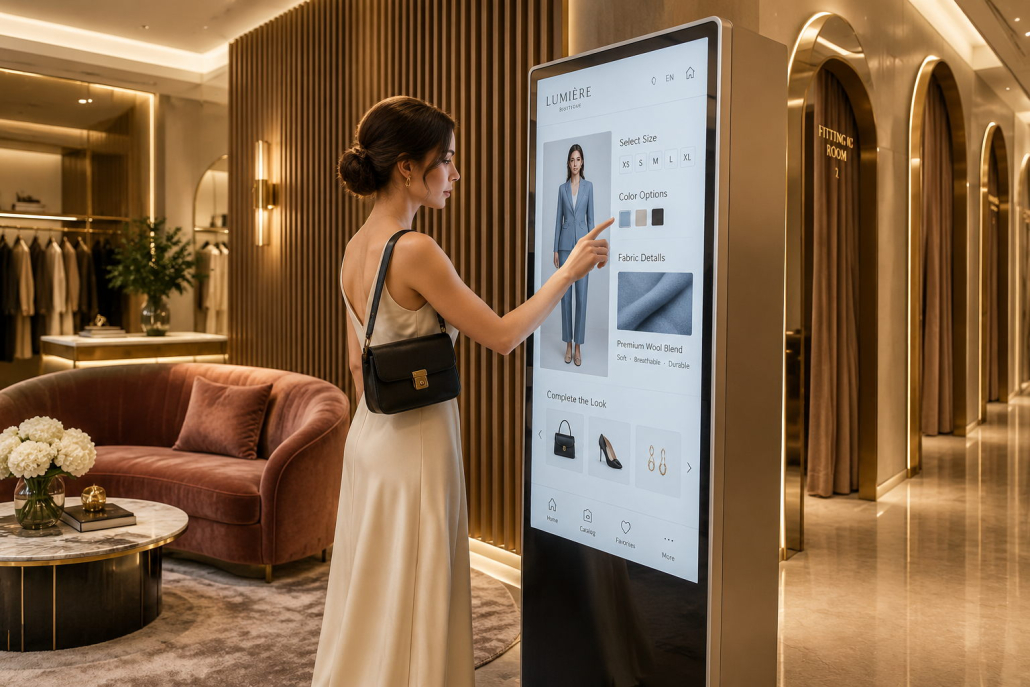
Depending on the hardware and software configuration, useful capabilities may include:
- Scheduled content playback
- Remote content updates
- Centralized campaign management
- Multi-screen playlist management
- Remote device monitoring
- Scheduled power on and off
- Automatic brightness adjustment, where supported
Before choosing a platform, verify compatibility with the display hardware, network requirements, user permissions, software licensing, and ongoing support arrangements.
For larger retail networks, it is also useful to define who can publish content, how campaigns are approved, and how stores handle temporary network or device issues.
9. What Should Fashion Retailers Look for in a Commercial Display Manufacturer?
For fashion brands, retail solution providers, distributors, and system integrators, selecting a capable manufacturer is an important part of project planning.
Consider the following factors:
Product range: Can the supplier offer indoor commercial displays, high-brightness window displays, double-sided displays, and other relevant formats?
Technical support: Can the supplier help assess brightness, screen size, mounting, operating hours, and installation conditions?
OEM/ODM capabilities: Can the supplier discuss customization options such as enclosure design, mounting structures, branding, connectivity, and project-specific configurations?
Quality assurance: Are product specifications, inspection procedures, and applicable test documentation available for the quoted model?
Compliance: Can the supplier provide relevant certification or compliance documents for the exact product configuration and destination market?
Production and delivery: Can the supplier support the required quantity, sample approval process, production schedule, and packaging requirements?
After-sales support: Are warranty terms, troubleshooting procedures, and spare-parts arrangements clearly defined?
For large deployments, request a sample or pilot batch and establish acceptance criteria before mass production. Confirm the final specifications in writing so that the delivered product matches the approved configuration.
10. OEM/ODM Digital Signage Solutions for Fashion Retail Projects
Standard commercial displays can meet many retail requirements. However, fashion brands, distributors, and system integrators may need custom configurations for particular storefronts or multi-location projects.
Depending on technical feasibility, OEM/ODM discussions may include:
- Screen size and display configuration
- Brightness options for different lighting conditions
- Single-sided or double-sided display formats
- Enclosure dimensions, colors, and branding
- Ceiling-suspended, wall-mounted, or floor-standing installation
- Connectivity and content-management requirements
- Power scheduling and light-sensor options
- Packaging, labeling, and documentation
- Project-specific inspection and testing requirements
To obtain an accurate quotation, provide the supplier with the target market, intended application, installation photos or drawings, required specifications, estimated quantity, and expected delivery schedule.
Clear requirements help manufacturers recommend appropriate models, evaluate customization feasibility, and reduce the risk of changes during deployment.
11. Digital Signage Checklist for Fashion Retail Stores
Before confirming your purchase, review the following points:
- Is the display suitable for indoor or window-facing installation?
- Is the brightness appropriate for the actual lighting conditions?
- Are screen size, resolution, orientation, and aspect ratio correct?
- Does the design fit the store’s visual identity and available space?
- Are operating hours and thermal requirements appropriate?
- Are mounting, power, and cable-routing requirements confirmed?
- Are content playback and remote management functions clearly specified?
- Have software licensing and network requirements been checked?
- Are applicable compliance documents and warranty terms available?
- Can the supplier support the required order quantity and customization?
Planning a digital signage project for your fashion retail business?
Contact Kontech with your application, screen size, brightness requirements, estimated quantity, and customization needs. Our team can help you evaluate commercial display options for your retail project.

