
Outdoor LCD Display vs LED Display: Which Solution Is Better?
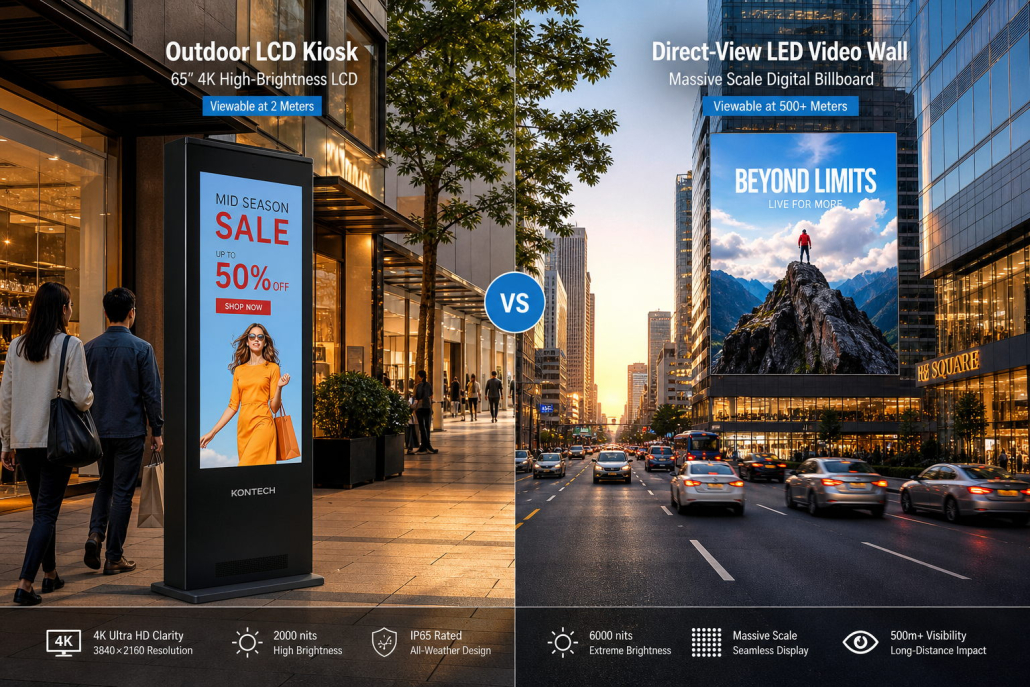
When planning an outdoor commercial digital signage rollout—whether for retail storefronts, municipal transit hubs, quick-service restaurant (QSR) drive-thrus, or roadside commercial billboards—AV consultants and enterprise buyers invariably confront a fundamental hardware dilemma:
“Should we deploy high-brightness Outdoor LCD displays, or should we invest in Direct-View LED video walls?”
Both display technologies dominate the modern out-of-home (OOH) landscape, yet they are engineered upon radically different physical architectures, optical mechanisms, and operational economics. Choosing the wrong technology for your specific installation environment leads to severe operational compromises: pixelated, unreadable text for close-up pedestrians, insufficient brightness under intense solar exposure, thermal runaway, or blown capital budgets.
In this authoritative engineering guide, we break down the fundamental architectural differences between Outdoor LCD (Liquid Crystal Display) and Direct-View LED (Light Emitting Diode) displays across six critical commercial dimensions: visual resolution, viewing distance, sunlight readability, weatherproofing, energy efficiency, and total cost of ownership (TCO), anchored by Kontech’s industrial commercial display engineering standards.
1. Underlying Technology: How Outdoor LCD and LED Screens Work
To make an informed procurement decision, AV engineers and project stakeholders must first understand how each screen generates imagery.
Architectural Comparison: Outdoor LCD vs Direct-View LED
┌──────────────────────────────────────┐  ┌──────────────────────────────────────┐
│       OUTDOOR LCD ARCHITECTURE       │  │      DIRECT-VIEW LED ARCHITECTURE     │
│ ┌──────────────────────────────────┐ │  │ ┌──────────────────────────────────┐ │
│ │ 5mm AR / AG Tempered Glass       │ │  │ │ Protective Silicone Conformal Mask │ │
│ ├──────────────────────────────────┤ │  │ ├──────────────────────────────────┤ │
│ │ Liquid Crystal Matrix (Pixels)   │ │  │ │ Discrete Surface-Mount LEDs      │ │
│ ├──────────────────────────────────┤ │  │ │ (Red, Green, Blue Diodes = Pixel)│ │
│ │ Polarizing Optical Filters (QWP) │ │  │ ├──────────────────────────────────┤ │
│ ├──────────────────────────────────┤ │  │ │ Modular LED Tile PCB             │ │
│ │ High-Power LED Backlight Array   │ │  │ ├──────────────────────────────────┤ │
│ └──────────────────────────────────┘ │  │ │ Cast Aluminum Sub-Cabinet         │ │
│ [Backlight shines THROUGH crystals]  │  │ [Individual Diodes EMIT light directly]
└──────────────────────────────────────┘  └──────────────────────────────────────┘
Outdoor LCD (Liquid Crystal Display)
An outdoor commercial LCD is a transmissive display system. The liquid crystal layer does not emit light on its own. Instead, an ultra-high-power LED backlight array (producing 2,000 to 3,500 nits) sits behind optical diffusion layers and shines white light through red, green, and blue sub-pixel liquid crystal shutters.
- Fixed High Pixel Density: Because millions of microscopic pixels are etched onto a continuous glass substrate, outdoor LCDs deliver native 1080P Full HD (32″–55″) or 4K Ultra HD (65″–75″+) resolution within compact, single-panel form factors.
- Protective Enclosure Integration: In Kontech’s ODF series, the LCD cell is protected behind an optical-grade 5mm IK10 vandal-proof tempered glass finished with Anti-Reflective (AR) and Anti-Glare (AG) coatings, housed in a sealed aluminum alloy chassis.
Direct-View LED (Light Emitting Diode Display)
A Direct-View LED screen is an emissive display system. It contains no liquid crystals, optical polarizers, or separate backlights. Instead, millions of microscopic Surface-Mount Device (SMD) or Chip-on-Board (COB) LEDs are mounted directly onto modular printed circuit boards (LED tiles). Each pixel consists of individual red, green, and blue diodes emitting light directly toward the viewer.
- Modular Video Wall Scalability: Direct-View LED displays are assembled from seamless modular tiles (typically 500×500 mm or 960×960 mm cabinets). They can be scaled infinitely into colossal roadside billboards or curved architectural facades without visible bezels.
- Pixel Pitch Dictates Resolution: Resolution is governed strictly by pixel pitch (the physical distance between diode centers, such as P2.5, P3.9, P6, or P10). Achieving 4K resolution on an outdoor LED display requires massive physical dimensions.
2. Resolution, Pixel Density, and Viewing Distance
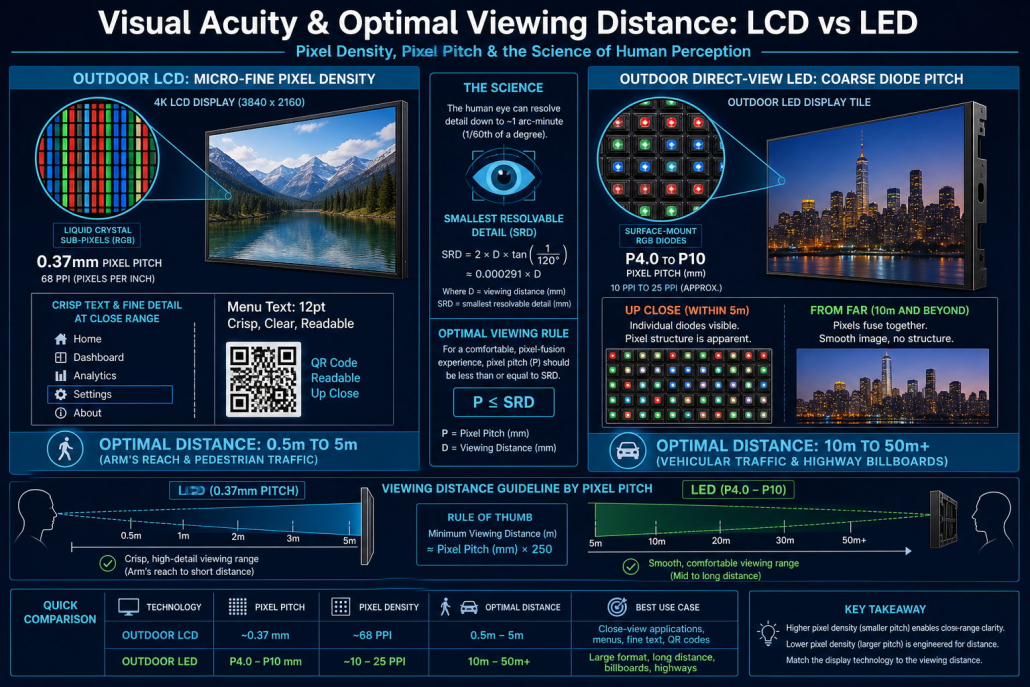
The single most critical technical factor dictating whether to choose LCD or LED is the intended viewing distance of your audience.
Viewing Distance vs Resolution Sweet Spot:
 0m                3m                5m                10m               20m+
 ├─── LCD DOMAIN ──┼──────── TRANSITION ZONE ──────────┼───── LED DOMAIN ────►
 (High-PPI 1080P/4K) (Fine-Pitch LED P1.5–P2.5)         (Outdoor LED P4–P10)
 Close-Up Foot Traffic                                 Drive-By Highway Traffic
 Wayfinding, Menus, Kiosks                             Stadiums, Giant Billboards
When Outdoor LCD Wins: Close-Up and Medium Viewing Distances (< 5 Meters / 16 Feet)
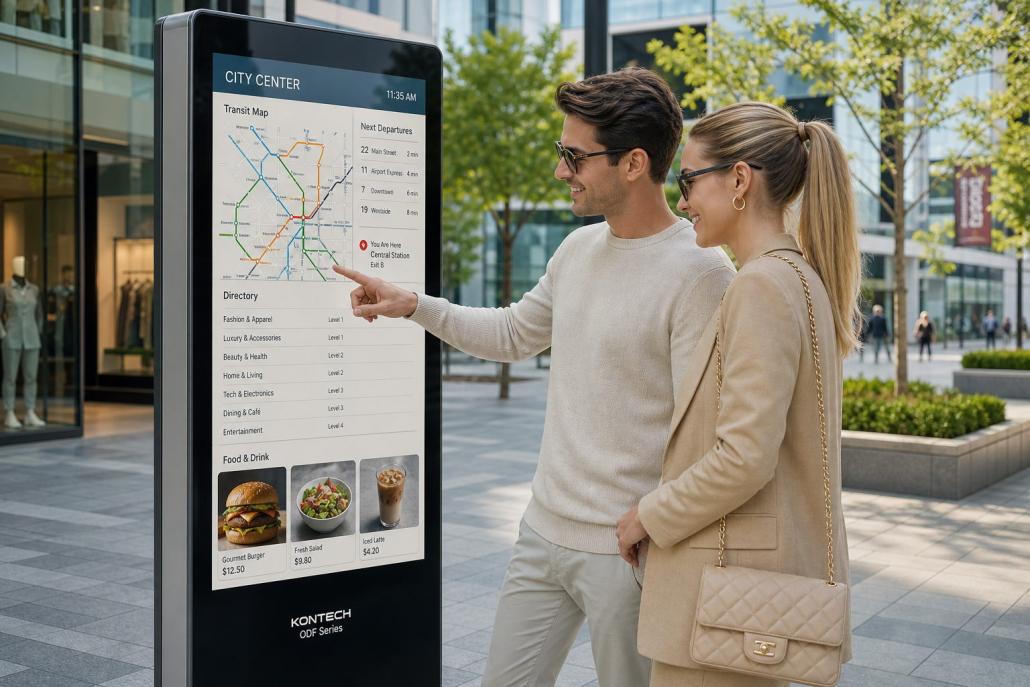
When viewers stand within arm’s reach or a few paces from the screen (pedestrians at a transit stop, customers at a drive-thru menu board, or shoppers at a wayfinding kiosk), image sharpness and text legibility are paramount.
- A 55-inch 1080P or 65-inch 4K outdoor LCD boasts a pixel density of 40 to 68+ PPI (Pixels Per Inch), with an effective pixel pitch under 0.37 mm to 0.63 mm.
- Small 12-point menu fonts, QR codes, barcode boarding passes, and intricate retail graphics appear razor-sharp with zero visible pixelation or grain.
- Attempting to match this resolution with an outdoor LED display would require an ultra-fine pixel pitch of P0.9 to P1.2, which is prohibitively expensive, thermally vulnerable, and structurally fragile for harsh outdoor conditions.
When Direct-View LED Wins: Long-Distance Viewing (> 8 to 10 Meters / 26+ Feet)
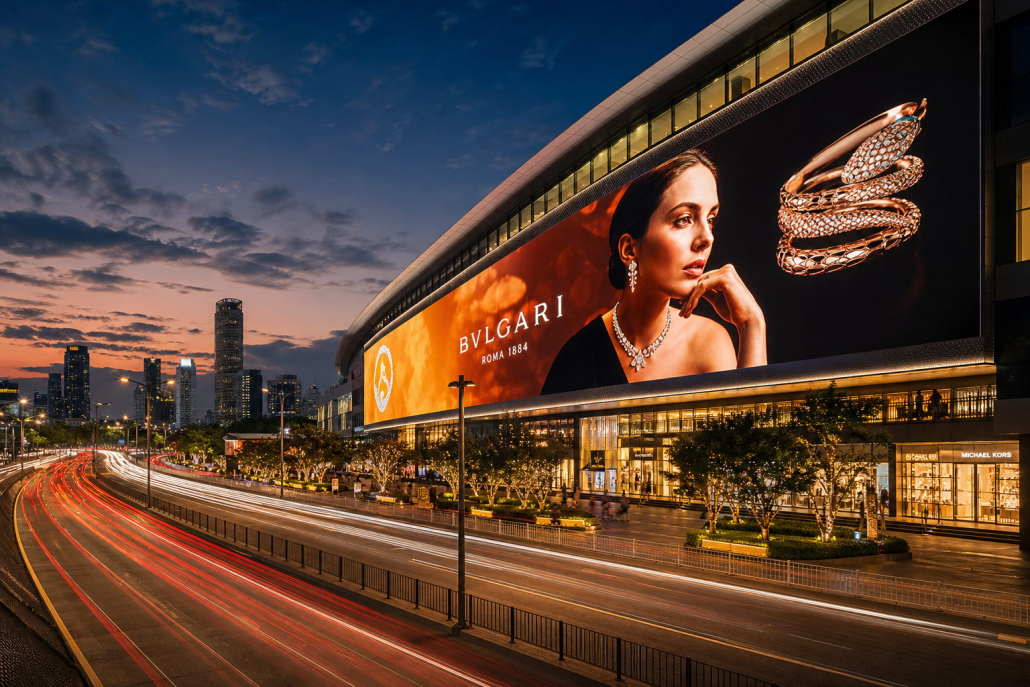
When your target audience consists of motorists driving past on an arterial highway or spectators sitting across a football stadium, micro-fine resolution is irrelevant. Human visual acuity cannot resolve individual pixels beyond specific distance thresholds:
- Standard outdoor LED billboards utilize pixel pitches ranging from P4.0 (4 mm) to P10 (10 mm).
- At viewing distances of 10 to 50+ meters, these coarse diode pitches merge optically in the human eye into smooth, continuous imagery.
- Furthermore, because LED cabinets are borderless, they scale into massive 200-inch, 500-inch, or larger displays that an LCD video wall cannot match without distracting cross-hatch bezel seams.
3. Sunlight Readability, Brightness, and Optical Contrast
Outdoor displays must combat the ultimate optical adversary: direct sunlight irradiance exceeding 100,000 lux on clear summer afternoons.
Brightness Comparison in Full Solar Exposure:
┌────────────────────────────────────────────────────────────────────────┐
│ DIRECT-VIEW LED BILLBOARD  ████████████████████████ 5,000–8,000 Nits   │
├────────────────────────────────────────────────────────────────────────┤
│ KONTECH OUTDOOR LCD (ODF)  ████████████ 2,000–3,500 Nits (AR Glass)    │
├────────────────────────────────────────────────────────────────────────┤
│ INDOOR TV (UNPROTECTED)    ██ 300–400 Nits (Completely Invisible)       │
└────────────────────────────────────────────────────────────────────────┘
Brightness Benchmarks
- Outdoor LCD Displays: Premium commercial outdoor LCDs (such as Kontech’s ODF series) feature high-output custom LED edge-lit or direct-lit backlights generating 2,000 to 2,500 cd/m² (nits) as standard, with custom engineering supporting up to 3,500 nits.
- Direct-View LED Displays: High-power outdoor LED tiles easily output 5,000 to 8,000+ nits, allowing them to blast through harsh ambient light across hundreds of feet.
The Optical Contrast Nuance: AR Glass vs Raw Diodes
Brightness in isolation does not guarantee readability; contrast ratio under ambient illumination is equally vital.
- A 2,500-nit Kontech outdoor LCD equipped with optical Anti-Reflective (AR) glass reduces surface specular reflection by 98%, maintaining rich 1200:1 to 3000:1 static contrast even in bright daylight without blinding nearby viewers.
- Direct-View LED’s raw 6,000-nit luminance is spectacular from a highway, but viewing it from 2 meters away causes severe optical glare, ocular fatigue, and localized light pollution.
4. Ingress Protection, Vandal Resistance, and Maintenance
Outdoor commercial hardware must endure relentless environmental punishment: rainstorms, blowing silt, road grime, freezing blizzards, and vandalism.
Physical Protection & Vandalism
In public, unsupervised commercial areas (transit shelters, downtown sidewalks, shopping arcades), screens face physical abuse.
- Kontech outdoor LCD monitors feature a continuous, flat sheet of 5mm IK10-certified tempered safety glass capable of absorbing 20 Joules of physical impact (the equivalent of a 5kg steel ball dropped from 400mm). Graffiti and stickers wipe clean with standard industrial solvents.
- Direct-View LED displays feature thousands of exposed, fragile diode solder joints protected only by plastic masks. Vandalism or thrown debris easily knocks off individual diodes, resulting in unsightly dead pixels requiring complex tile repairs.

5. Architectural Footprint, Power Consumption, and Total Cost of Ownership (TCO)
Evaluating display technology requires looking beyond the initial purchase price to consider long-term structural, electrical, and maintenance costs.
Total Cost of Ownership (TCO) Breakdown Over 5-Year Lifecycle:
┌─────────────────────────┬──────────────────────────┬──────────────────────────┐
│ COST COMPONENT          │ OUTDOOR LCD (32"–75")    │ OUTDOOR LED (<100" vs >120")│
├─────────────────────────┼──────────────────────────┼──────────────────────────┤
│ Initial Hardware Cost   │ Predictable, economical  │ Costly for small screens;│
│                         │ for compact formats      │ Economical for >120"     │
├─────────────────────────┼──────────────────────────┼──────────────────────────┤
│ Structural Weight & Rig │ Slim cabinet (19–50 kg); │ Heavy steel unistrut/    │
│                         │ Standard VESA wall mount │ crane truss rigging      │
├─────────────────────────┼──────────────────────────┼──────────────────────────┤
│ Typical Operating Power │ 210W (32") to 480W (65") │ 800W–2,500W+ per m²      │
│                         │ (Auto-dimming saves 35%) │ (Peak draw on white copy)│
├─────────────────────────┼──────────────────────────┼──────────────────────────┤
│ Routine Service Costs   │ Minimal; sealed chassis  │ Periodic diode soldering │
│                         │ requires zero recalibr.  │ & tile color balancing   │
└─────────────────────────┴──────────────────────────┴──────────────────────────┘- Size Threshold Dynamics: For screen sizes under 100 inches (e.g., 43″, 55″, 65″, 75″), outdoor LCD is substantially more cost-effective per square meter while delivering 10x to 30x higher pixel density. Conversely, above 120 to 150 inches, Direct-View LED becomes the superior choice, as manufacturing monolithic LCD panels of that scale is physically unfeasible.
- Thermal & Electrical Load: Driving millions of individual LEDs at 6,000 nits consumes immense electrical wattage, often requiring dedicated commercial 3-phase power drops. A Kontech 65-inch outdoor LCD operates at an efficient 480W, with intelligent ambient light auto-dimming throttling consumption down to 250W at night.
- Weight & Structural Engineering: A 55-inch Kontech outdoor LCD weighs just 31 kg, mounting easily to existing architectural pillars or brick facades with standard VESA 400×400mm heavy-duty brackets. An equivalent LED video wall with structural backing frames and receiving cards often requires reinforced structural steel sub-frames and municipal engineering permits.
6. The Verdict: Comprehensive Selection Decision Matrix
To streamline your procurement evaluation, apply this practical decision matrix:
7. Frequently Asked Questions (FAQ)
Q1: Can an outdoor LCD display match the brightness of an LED billboard?
A: For close-to-medium range viewing, yes. While outdoor LED displays produce 5,000–8,000 nits for long-distance highway readability, Kontech outdoor LCD monitors output 2,000 to 3,500 nits. When coupled with optical anti-reflective (AR) glass, this provides complete sunlight readability and superior visual comfort without blinding pedestrians standing 1 to 3 meters away.
Q2: Which technology lasts longer outdoors: LCD or LED?
A: Both technologies deliver enterprise-grade longevity when engineered properly. Kontech outdoor LCD displays feature industrial LED backlights rated for ≥50,000 hours of continuous 24/7 operation with uniform optical degradation. High-quality Direct-View LEDs are rated for 80,000 to 100,000 hours, but they are prone to localized single-pixel diode failures and chromatic drift that require frequent maintenance over their operational life.
Q3: Can outdoor LCD displays be seamlessly tiled into video walls?
A: While ultra-narrow bezel LCDs can be tiled (with seams as narrow as 0.88mm to 3.5mm), environmental moisture seals and outdoor protective glass require structural frames of approximately 25.5mm bezel width (as on the Kontech ODF series). For massive, 100% seamless giant video walls, Direct-View LED remains the definitive choice. For standalone kiosks, bus shelters, and drive-thrus under 100 inches, standalone outdoor LCD is vastly superior.

